GeoGebra

Misconception: Skydiver goes up when parachute opens

When a parachute opens, many people think the parachutist suddenly shoots upward. This is not what really happens. The parachutist is always moving downward, but the parachute causes a very sharp deceleration. The large canopy produces a big upward drag force that slows the fall dramatically.

When people see videos of parachutists opening their parachutes, the camera angle can create a powerful illusion that the parachutist suddenly shoots upward. What really happens is that the parachutist decelerates sharply while the camera, usually attached to another skydiver, continues falling at almost the same high speed.

From the perspective of the camera, the parachutist with the open parachute is no longer keeping pace in the fall. The camera-holder is still dropping rapidly, but the parachutist has slowed down. In the video, this relative motion makes it look like the parachutist has bounced upward, when in fact they are still moving downward—just not as quickly.

The physics of air resistance shows clearly why the velocity cannot turn upward. Air resistance always acts opposite to the velocity and its size depends on speed. Before and after the parachute opens, the parachutist’s velocity is downward, so the drag force must be upward. If the parachutist’s velocity really were upward, then the drag would have to point downward. In that case, the resultant force would also point downward, making the acceleration greater than gravity—something we never observe. Instead, the drag force remains upward, which proves the parachutist is still moving downward the whole time. The chute simply reduces that downward speed to a safe value.

For a simulation on how the forces and velocity change with time, refer to this GeoGebra app.
RC Circuit

Open in new tab đź”—

This is meant for the A-level topic of Circuits, for which students have to describe and represent the variation with time, of quantities like current, charge and potential difference, for a capacitor that is charging or discharging through a resistor, using equations of the form $x = x_0e^{-\frac{t}{\tau}}$ or $x = x_0(1 – e^{-\frac{t}{\tau}})$, where $\tau = RC$ is the time constant.

This GeoGebra interactive by Dave Nero is well-designed. It illustrates how the charge, voltage, and current in an RC circuit change over time. You can adjust the resistance, capacitance, and supply voltage using the sliders provided. The two circuit switches can be opened or closed by selecting the check boxes. A drop-down menu allows you to choose which quantity to display on the graph, and pressing the play button in the lower left corner starts the time-dependent plot.

When a capacitor is connected in series with a resistor, the changes in current, charge and potential difference follow an exponential pattern, controlled by the time constant $\tau = RC$.

During charging, the capacitor begins with no charge, so the battery’s full potential difference appears across the resistor, giving a maximum initial current. As charge accumulates on the plates, the potential difference across the capacitor rises. This reduces the potential difference across the resistor, causing the current to decrease. The charge on the capacitor and its potential difference both increase with time according to the equation $x = x_0 \left(1 – e^{-t/\tau}\right)$, approaching their maximum values asymptotically. Meanwhile, the current decreases exponentially with time, following $x = x_0 e^{-t/\tau}$.

During discharging, the capacitor starts with an initial charge and potential difference. Once connected across the resistor, this stored energy drives a current in the circuit. As the charge leaves the plates, the potential difference across the capacitor falls. Both charge and potential difference decrease exponentially with time according to $x = x_0 e^{-t/\tau}$, and the current also decays exponentially to zero, reversing direction compared to charging.

The time constant $\tau = RC$ sets the rate of change. After one time constant, a charging capacitor reaches about 63% of its final charge, or a discharging capacitor falls to about 37% of its initial charge. After about five time constants, the process is practically complete.

3D view of forces on parallel currents using GeoGebra

Open in new tab đź”—

The simulation serves to show how the magnetic field of one current-carrying wire exerts a force on another current-carrying wire.

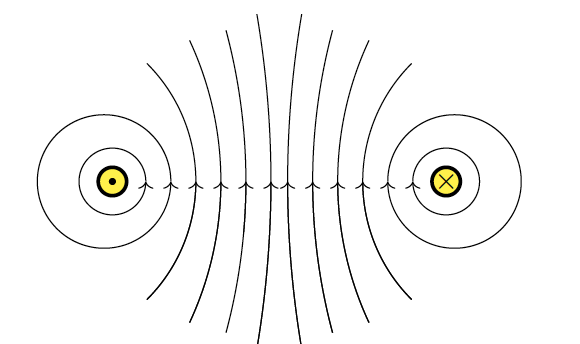
When two wires are placed parallel to each other and carry electric currents, each wire produces its own magnetic field. The magnetic field around a straight current-carrying conductor forms concentric circles, and the direction of these circles can be determined by the right-hand grip rule: if you point your thumb along the direction of the current, your curled fingers show the direction of the magnetic field lines.

Because of this, one wire is always sitting inside the magnetic field created by the other. The moving charges in the second wire—that is, the current—interact with this magnetic field and experience a force. The strength of the force depends on the current in both wires and the distance between them, while the direction of the force can be worked out using Fleming’s left-hand rule or simply by considering how the two fields interact.

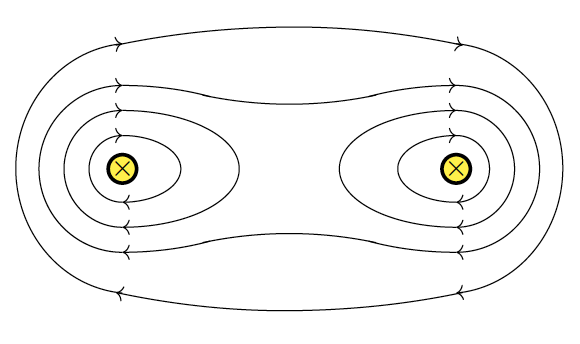
Magnetic field patterns between two parallel currents interact in such a way as to form either an attraction (for currents in same direction) or a repulsion (for opposite currents)

If the currents in the two wires flow in the same direction, the magnetic fields between the wires reinforce each other, producing a stronger field outside the pair and a weaker field between them. This imbalance pulls the wires towards each other, so they attract. On the other hand, if the currents run in opposite directions, the magnetic fields between the wires reinforce instead, while the fields outside are weakened. The result is a pushing apart of the two wires, so they repel each other.

In short, the force on parallel wires arises because each wire generates a magnetic field that acts on the current in the other. Identifying the force is straightforward once you know the directions of the currents: currents in the same direction cause attraction, while currents in opposite directions cause repulsion.

Kinematics Graphs Interactive

Understanding motion in physics often involves analyzing displacement, velocity, and acceleration graphs. With the interactive GeoGebra graph at this link, you can dynamically explore how these concepts are connected.

How It Works

This interactive simulation lets you visualize an object’s motion and its corresponding displacement-time, velocity-time, and acceleration-time graphs. You can interact with the model in two key ways:

  1. Adjust Initial Conditions:
    • Move the dots on the graph to change the starting displacement, velocity, or acceleration.
    • Observe how these changes influence the overall motion of the object.
  2. Use the Slider to Animate Motion:
    • Slide through time to see how the object moves along its path.
    • Watch the displacement vector, velocity vector, and acceleration vector update in real time.

Key Observations

  • When displacement changes, the velocity and acceleration graphs adjust accordingly.
  • A constant acceleration results in a straight-line velocity graph and a quadratic displacement graph.
  • Negative acceleration (deceleration) slows the object down and can cause direction reversals.
  • If velocity is constant, the displacement graph is linear, and acceleration remains at zero.

Why This is Useful

This GeoGebra tool is perfect for students and educators looking to build intuition about kinematics. Instead of just solving equations, you get a visual and hands-on way to see the relationships between these key motion variables.

Try it out yourself and experiment with different conditions to deepen your understanding of motion!

Symposium on Tech for Engagement at SISTC 2024

This deck of slides are the ones I will be using for the Symposium on “Leveraging Technology for Engaging and Effective Learning” at the Singapore International Science Teachers’ Conference (SISTC) 2024 on Day 2 of the Conference (20 November). Feel free to download for your reference.

DC Circuits Practice

The simulation below allows students to practise calculating potential differences and currents of a slightly complex circuit, involving three different modes that can be toggled by clicking on the switch.

Open in new tab đź”—

Link: https://www.geogebra.org/m/jkckp9pr

Mode 1: Two Resistors in Series

When resistors \( R_1 \) and \( R_2 \) are connected in series, the total resistance is simply the sum of the individual resistances:

\[ R_{\text{total}} = R_1 + R_2 \]

The current \( I \) through the circuit is given by Ohm’s Law:

\[ I = \frac{V_{\text{total}}}{R_{\text{total}}} = \frac{V_{\text{total}}}{R_1 + R_2} \]

where \( V_{\text{total}} \) is the total potential difference supplied by the source.

The potential difference across each resistor can be calculated using:

\[ V_1 = I \cdot R_1, \quad V_2 = I \cdot R_2 \]

Mode 2: \( R_1 \) and \( R_3 \) in Parallel, \( R_2 \) in Series

In this mode, resistors \( R_1 \) and \( R_3 \) are in parallel, and \( R_2 \) is in series with the combination. First, calculate the equivalent resistance of the parallel combination:

\[ \frac{1}{R_{\text{parallel}}} = \frac{1}{R_1} + \frac{1}{R_3} \]

Thus, the total resistance is:

\[ R_{\text{total}} = R_{\text{parallel}} + R_2 \]

The current through the circuit is:

\[ I = \frac{V_{\text{total}}}{R_{\text{total}}} \]

The potential difference across \( R_2 \) is:

\[ V_2 = I \cdot R_2 \]

Since \( R_1 \) and \( R_3 \) are in parallel, they share the same potential difference:

\[ V_1 = V_3 = V_{\text{total}} – V_2 \]

The current through each parallel resistor can be found using Ohm’s Law:

\[ I_1 = \frac{V_1}{R_1}, \quad I_3 = \frac{V_3}{R_3} \]

Mode 3: \( R_1 \) and \( R_2 \) in Series, \( R_3 \) in Parallel

Here, resistors \( R_1 \) and \( R_2 \) are connected in series, and the combination is in parallel with \( R_3 \). First, calculate the resistance of the series combination:

\[ R_{\text{series}} = R_1 + R_2 \]

Then, find the total resistance of the parallel combination:

\[ \frac{1}{R_{\text{total}}} = \frac{1}{R_{\text{series}}} + \frac{1}{R_3} \]

The total current is:

\[ I = \frac{V_{\text{total}}}{R_{\text{total}}} \]

The voltage across the parallel combination is the same for both branches:

\[ V_1 + V_2 = V_3 = V_{\text{total}} \]

The current through \( R_3 \) is:

\[ I_3 = \frac{V_3}{R_3} \]

The current through \( R_1 \) and \( R_2 \), which are in series, is the same:

\[ I_{\text{series}} = \frac{V_{\text{total}}}{R_1 + R_2} \]

The voltage across each series resistor is:

\[ V_1 = I_{\text{series}} \cdot R_1, \quad V_2 = I_{\text{series}} \cdot R_2 \]