A Geiger-Muller (GM) counter is an instrument for detecting and measuring ionizing radiation. It operates by using a Geiger-Muller tube filled with gas, which becomes ionized when radiation passes through it. This ionization produces an electrical pulse that is counted and displayed, allowing users to determine the presence and intensity of radiation.
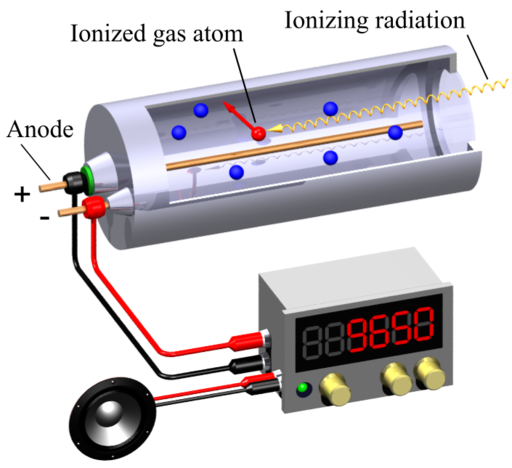
Svjo-2, CC BY-SA 3.0, via Wikimedia Commons

This simulation (find it at https://physicstjc.github.io/sls/gm-counter) allows students to explore the random nature of radiation and the significance of accounting for background radiation in experiments. Here’s a guide to help students investigate these concepts using the simulation.
Exploring Background Radiation
Q1: Set the source to “Background” and start the count. Observe the count for a few minutes. What do you notice about the counts recorded?
Q2: Why is it important to measure background radiation before testing other sources?
Investigating a weak source (e.g. banana) as a Radiation Source
Q3: Change the source to “Weak Source ” and reset the data. Start the count and observe the readings. How do the counts from the banana compare to the background radiation?
Q4: How do the counts per minute (CPM) for the weak source vary over time? Is there a pattern or do the counts appear random?
Exploring a strong source, e.g. Cesium-137 Source
Q5: Set the source to “Strong Source” and reset the data. Start the count and observe the readings. How do the counts from the strong source compare to both the background radiation and the weak source?
Understanding the Random Nature of Radiation
Q6: By looking at the sample counts, can you predict the next count value? Why or why not?
Q7: How can you use the background radiation measurement to correct the readings from the sources?