Technology

Pressure Nodes and Antinodes

Access in full screen here: https://www.geogebra.org/m/xbknrstt

I modified the progressive sound wave interactive into a stationary wave version.

This allows students to visualise the movement of particles about a displacement node to understand why pressure antinodes are found there.

Usually I will pose this question to students: where would a microphone pick up the loudest sound in a stationary sound wave? Invariantly, students will say it is at the antinode. When asked to clarify if it is the displacement antinode or pressure antinode, students then become uncertain.

According to Young & Geller (2007), College Physics 8th Edition, Pearson Education Inc. (pg 385), microphones and similar devices usually sense pressure variations and not displacements. In other words, the position within a stationary sound wave at which the loudest sound is picked up is at the displacement nodes which are the pressure antinodes.

For an alternative animation, check out Daniel Russell’s.

For embedding into SLS, please use the following code:

<iframe scrolling="no" title="Stationary Sound Wave (Displacement and Pressure)" src="https://www.geogebra.org/material/iframe/id/xbknrstt/width/640/height/480/border/888888/sfsb/true/smb/false/stb/false/stbh/false/ai/false/asb/false/sri/false/rc/false/ld/false/sdz/true/ctl/false" width="640px" height="480px" style="border:0px;"> </iframe>
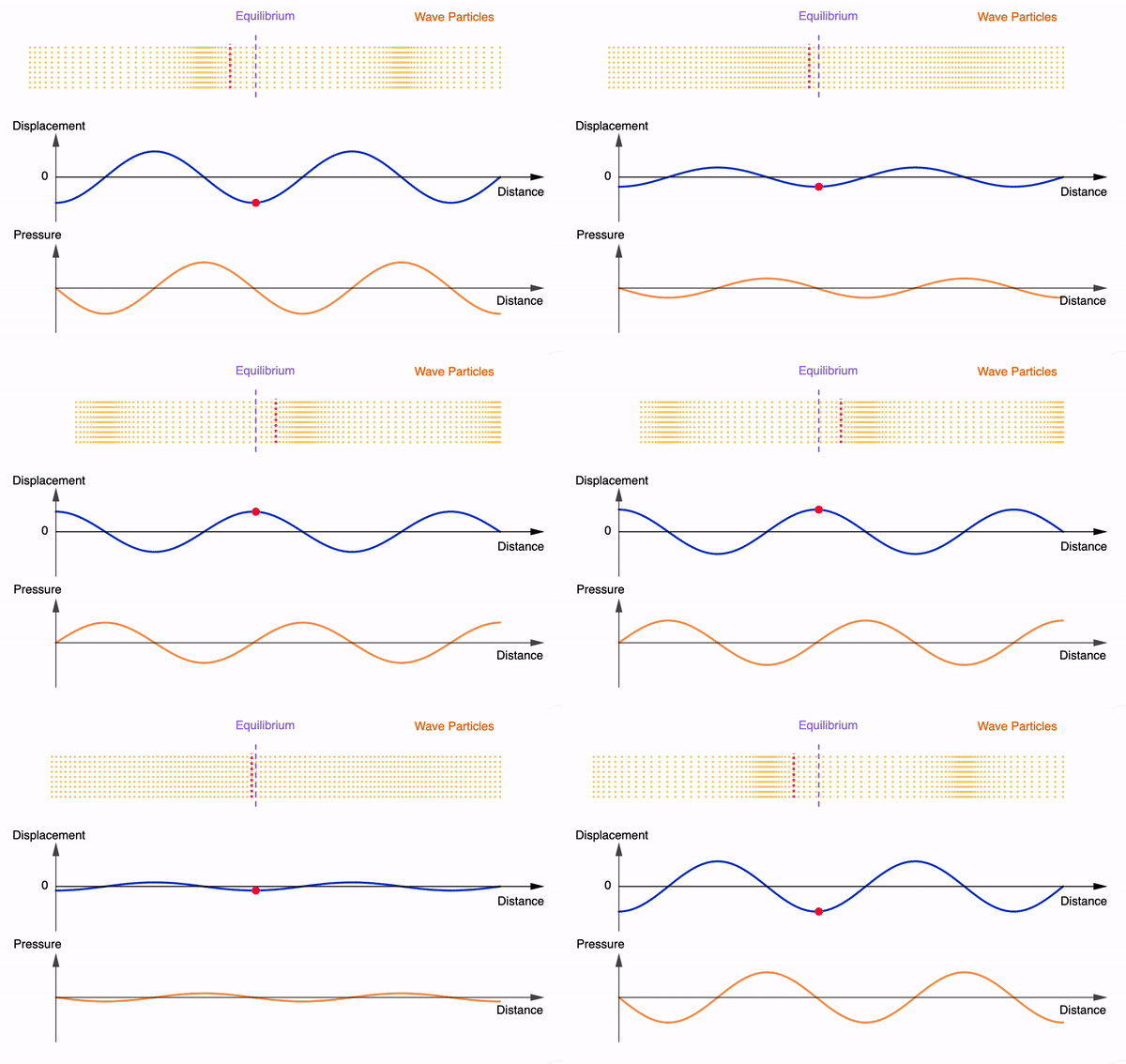
This animation gif file demonstrates the movement of particles in a stationary sound wave, displaying the changing displacement-distance and pressure-distance graphs simultaneously. It can be inserted into slides and websites. Free to use!

AC Power with Half-Wave Rectification

As a means of visualising what happens to the potential difference, current and power dissipated in an alternating current circuit with half-wave rectification, I have created the interactive applet with all 3 graphs next to each other.

It should be easy for students to see that with half-wave rectification, the power dissipated is half that of a normal a.c. supply with the same peak p.d. and current.

Root-mean-square Currents

The concept of root-mean-square values for Alternating Currents is challenging if students are to relate the I-t graph with the Irms value directly.

They have to be brought through the 3 steps before arriving at the Irms value. This interactive applet allows them to go through step by step and compare several graphs at one time to see the relationship.

Through the interaction, students might be asked to observe that the Irms value is never higher than the peak Io.

For a complete sinusoidal current:

For a diode-rectified current:

In comparing the Irms of both currents, students can be asked to consider why the ratio of the values is not 2:1 or any other value, from energy considerations.

Worked on this earlier as I am the lead lecturer for this JC2 topic and am trying to integrate useful elements of blended learning. Do let me know in the comments if you have ideas or feedback that you would like to share.

Pressure-Distance Graph of a Sound Wave

This GeoGebra applet was modified from an existing applet to show the relationship between the pressure-distance and displacement-distance graph of a progressive longitudinal wave.

Pythagorean Cup

This is a 3D printed Pythagorean cup, otherwise known as a greedy cup, where if one pours far too much water or wine or whatever your greedy heart desires, all the contents in the cup will leak out through the bottom.

This is based on the design by “jsteuben” on Thingiverse (https://www.thingiverse.com/thing:123252). The siphoning effect kicks in when the water level is above the internal “tube” printed and hidden into the walls of the cup.

I printed another cup based on a more conventional design as well, but due to the wrong settings given when I prepared the gcode file, the cup was rather leaky when the water level was low. This design by “MonzaMakers” has a protruding siphon tube. (https://www.thingiverse.com/thing:562790)

Explaining how the siphon works is easier with the second cup. When the water level is lower than the highest point in the siphoning tube, it remains in the cup. When it exceeds the highest point of the tube, water begins to flow down the part of the tube leading to the opening at the bottom of the cup. The falling water column creates a suction effect and continuously draws the rest of the water in, until the cup is dry.

3D Printed Tippe Top

After setting up my newest toy, the Creality Ender 3 V2 3D Printer, I started with a few simple prints from the Thingiverse website. The first Physics-related object created is for a colleague – a tippe top. This interesting mushroom-shaped toy is spun with the round top facing down. If it is spun fast enough, it will eventually spin upright, in the opposite orientation to where it started spinning. In doing so, it’s centre of mass even shifted upwards.

The source of the STL file is: https://www.thingiverse.com/thing:536377

The following video gives an explanation for why this happens.