Technology

3D printed teaching aids

I bought a Creality Ender 3D printer in 2020 (going at about $270 at Lazada now), at the height of the pandemic and have been using it to print physics-related teaching aids for a while, including balloon hovercrafts, catapults, a Pythagorean cup, tippy top and a vertical axis wind turbine. In addition to complete demonstration sets, it is also handy for printing parts to fix old demonstration sets such as a base for a standing cylinder with spouts at different heights.
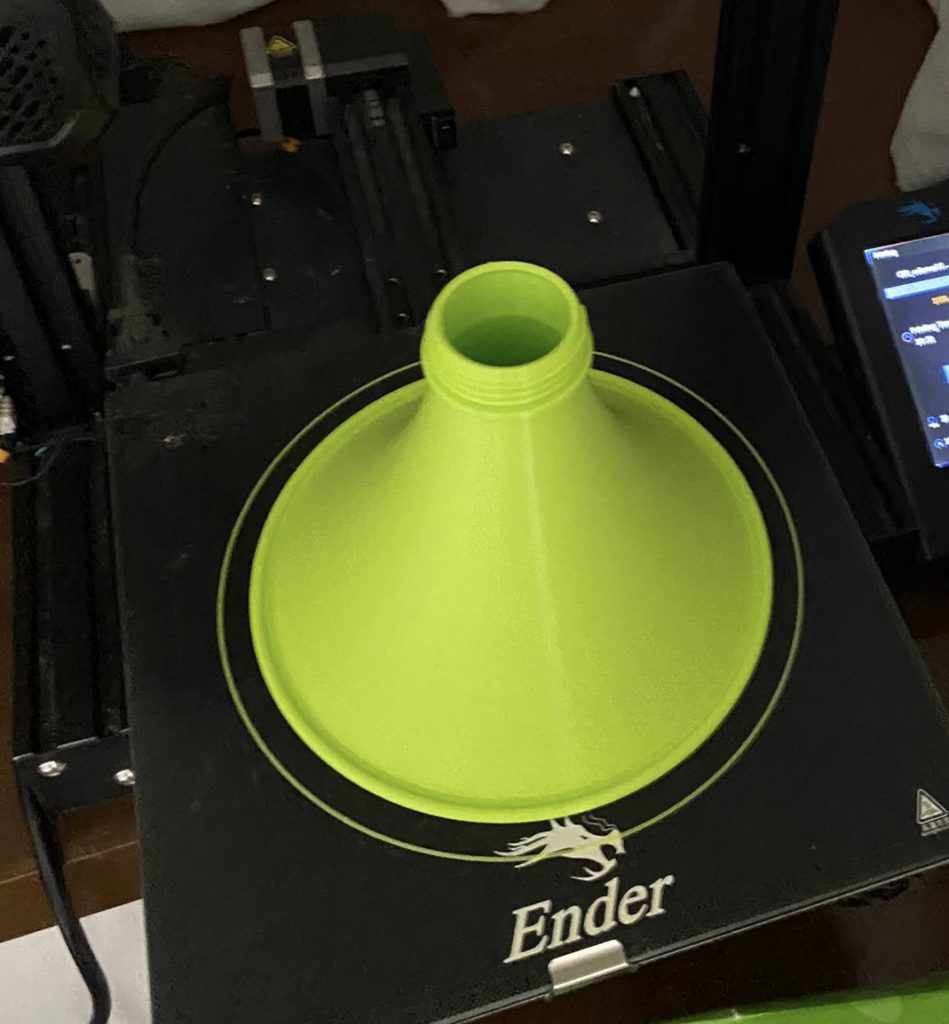
The Creality Ender 3 3D printer

This is a video compiled with the objects that I printed in recent months. The lime green filament that I used were purchased at $16.40 for 1 kg from Shopee. Therefore, each of the prints shown in the picture cost between forty cents to four dollars’ worth of filament.

The first is a coin funnel that can be used to demonstrate how centripetal force keeps objects moving in circles. As the energy of the coins decreases due to friction, the radius of the circle gets smaller and its speed actually increases. This forms a cognitive dissonance that often surfaces when we discuss satellites losing altitude in orbit.

The second is a tensegrity structure which can be used to teach about moments and equilibrium.

The third is a marble run set that was really just lots of fun to watch rather than teaching any difficult concept other than energy changes.

The fourth is a series of optical illusions that can be used to promote thinking about how light from reflections travel.

The final print is a cup holder that can be swung in vertical loops with a cup full of water. This is the most popular print among my colleagues and will certainly be used in term 3 for the JC1 lessons on circular motion.

Purpose of Fuse and Earth Wire

https://www.geogebra.org/m/pmatpapk

This applet highlights the parts of a circuit that becomes live depending on the state of a switch and the type of electrical fault in a device. It also demonstrates the roles of the fuse and earth wire in preventing accidents.

Internal Resistance and Terminal Potential Difference

https://www.geogebra.org/m/puvfjxk5

This applet demonstrates how terminal potential difference (as measured by the voltmeter across the terminals of the battery) changes depending on :

  1. internal resistance r
  2. external resistance R
  3. emf E
  4. when a switch is turned on and off
<iframe scrolling="no" title="Internal Resistance and Terminal Potential Difference" src="https://www.geogebra.org/material/iframe/id/puvfjxk5/width/640/height/480/border/888888/sfsb/true/smb/false/stb/false/stbh/false/ai/false/asb/false/sri/false/rc/false/ld/false/sdz/false/ctl/false" width="640px" height="480px" style="border:0px;"> </iframe>

Sky-Diving and Terminal Velocity

https://www.geogebra.org/m/wavar9bx

This is a wonderful applet created by Abdul Latiff, another Physics teacher from Singapore, on how air resistance varies during a sky-dive with a parachute. It clearly demonstrates how two different values of terminal velocity can be achieved during the dive.

Incidentally, there is a video on Youtube that complements the applet very well. I have changed the default values of the terminal velocities to match those of the video below for consistency.

Also relevant is the following javascript simulation that I made in 2016 which can show the changes in displacement, velocity and acceleration throughout the drop.

Potential Divider with Thermistor Applet

The wonderful thing about GeoGebra is that you can whip up an applet from scratch within an hour just before your lesson and use it immediately to demonstrate a concept involving interdependent variables. I was motivated to do this after trying to explain a question to my IP4 students.

The RGB colours of the thermistor reflects the temperature (red being hot, bluish-purple being cold)

https://www.geogebra.org/m/etszj23m

This was done to demonstrate the application of potential dividers involving a thermistor and a variable resistor. It can, of course, be modified very quickly to introduce other circuit components.

Newton’s 2nd Law Applet

For a full-screen view, click here.

<iframe scrolling="no" title="Dynamics Problem" src="https://www.geogebra.org/material/iframe/id/uthszwjq/width/640/height/480/border/888888/sfsb/true/smb/false/stb/false/stbh/false/ai/false/asb/false/sri/false/rc/false/ld/false/sdz/true/ctl/false" width="640px" height="480px" style="border:0px;"> </iframe>

This applet was designed with simple interactive features to adjust two opposing forces along the horizontal direction in order to demonstrate the effect on acceleration and velocity.