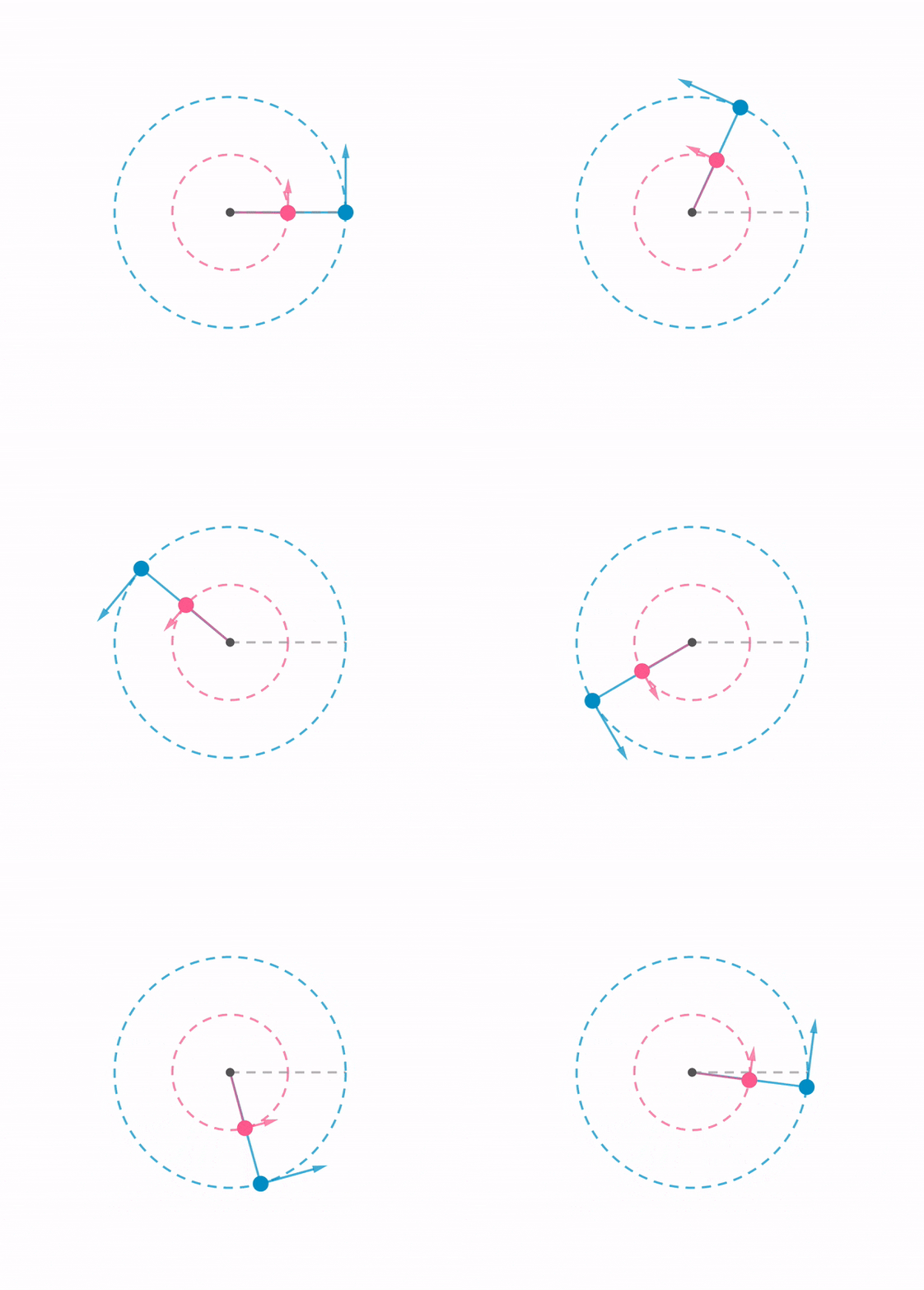
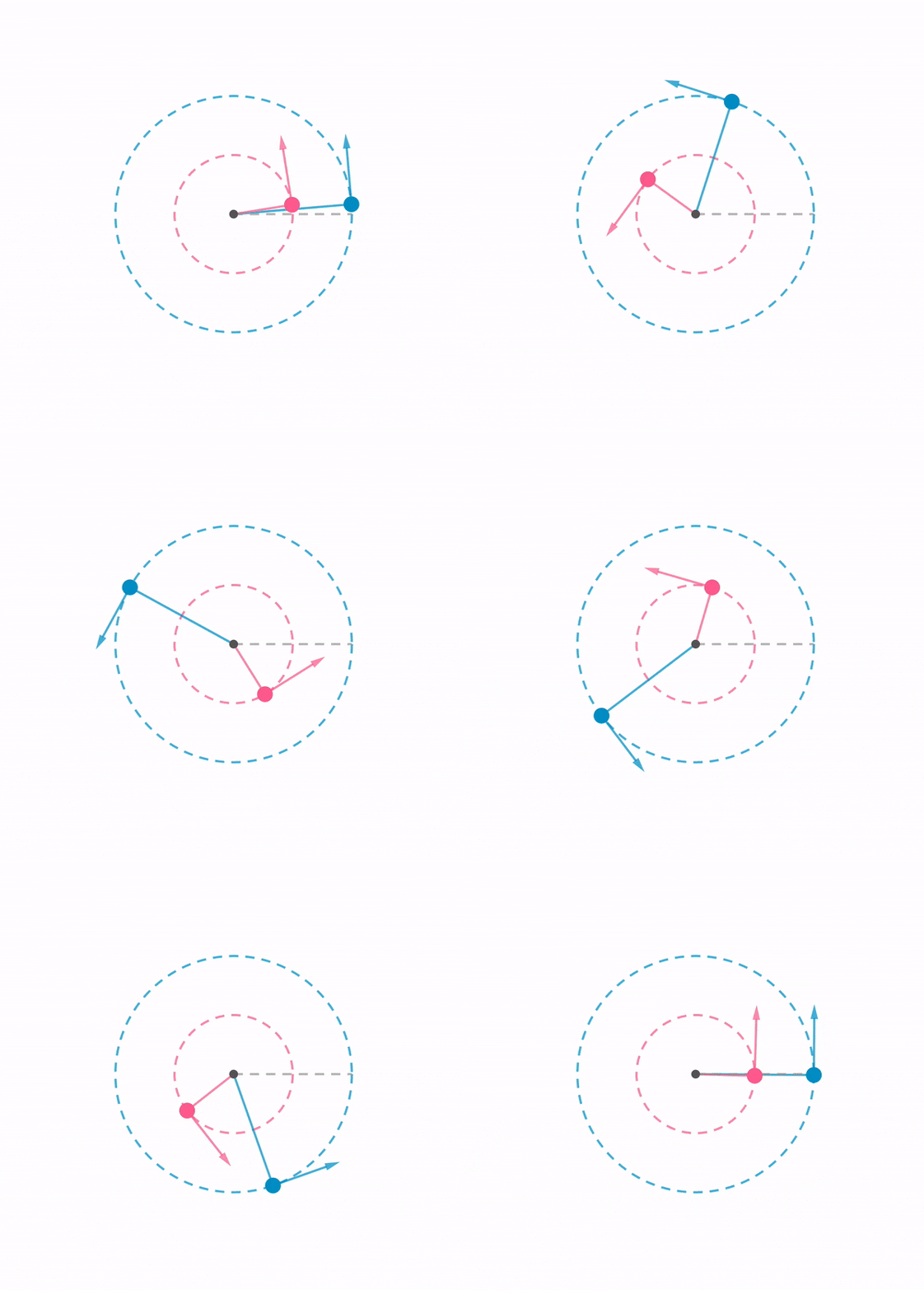
This GeoGebra app shows how angular velocity ω is the rate of change of angular displacement (i.e. $\omega=\dfrac{\theta}{t}$) and is dependent on the speed and radius of the object in circular motion (i.e. $v=r\omega$).
Students can explore the relationships by doing the following:
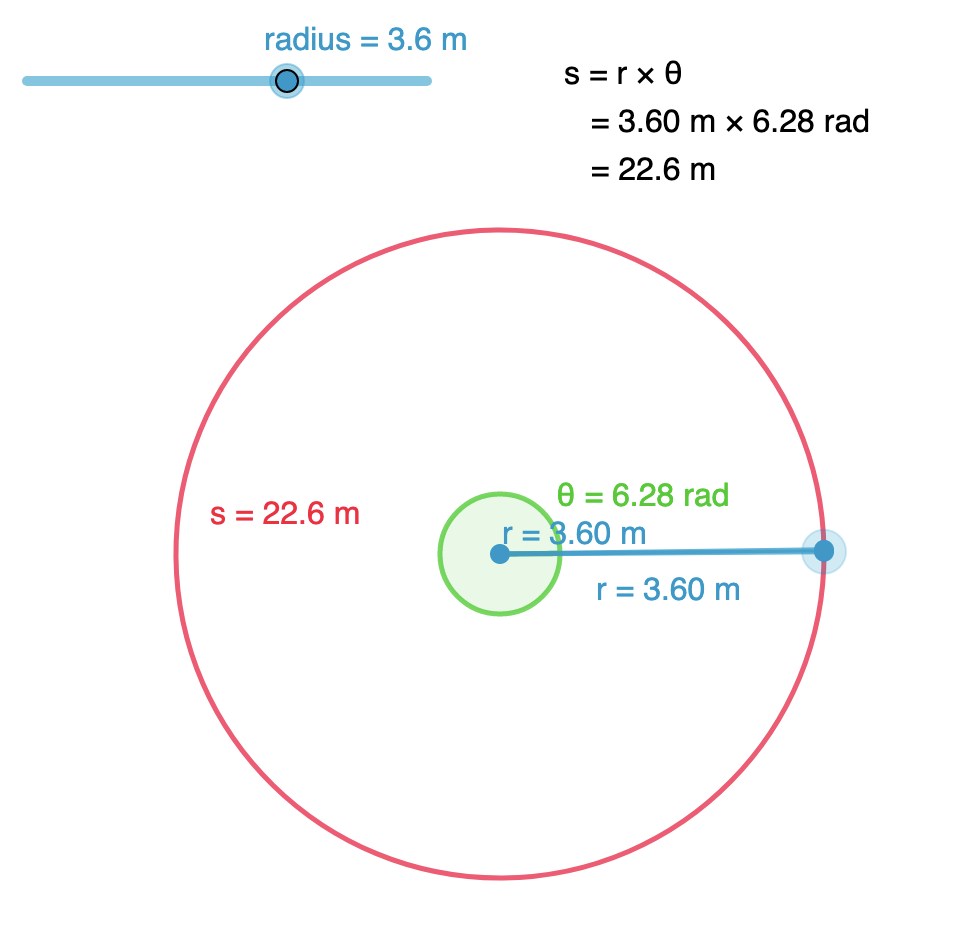
One activity I get students can do is to look at the value of θ when the arc length s is equal to the radius r. This would give the definition of the radian, which is the angle subtended at the centre of a circle by an arc equal in length to its radius.
Mathematics defines the constant π as the ratio of a circle’s circumference to its diameter. This can also be shown in the app, although you need to drag the moving point to a point just short of one full revolution.
While preparing to share with some fellow teachers in Singapore about the use of GeoGebra in Physics, I came up with a set of simple instructions to create an interactive, while introducing tools such as sliders, checkboxes (along with boolean values) and input boxes. Download it here.
You should be able to follow the instructions in the pdf document above and make a simple interactive applet yourself too. The outcome of the interactive applet will be like this:
Embedding GeoGebra into SLS
The following instructions are added on 19 Nov 2024 to update the screens available in SLS.
To embed a GeoGebra app into the Singapore Student Learning Space or any other LMS that supports iframe embedding, note the following:
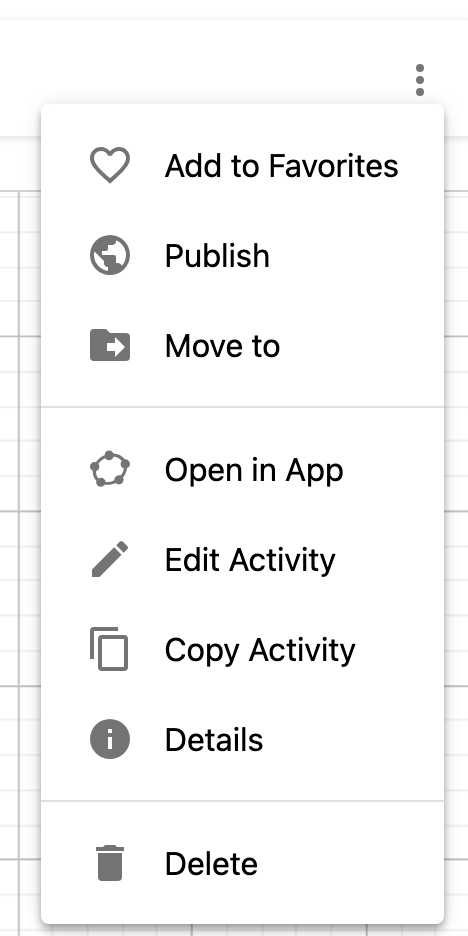
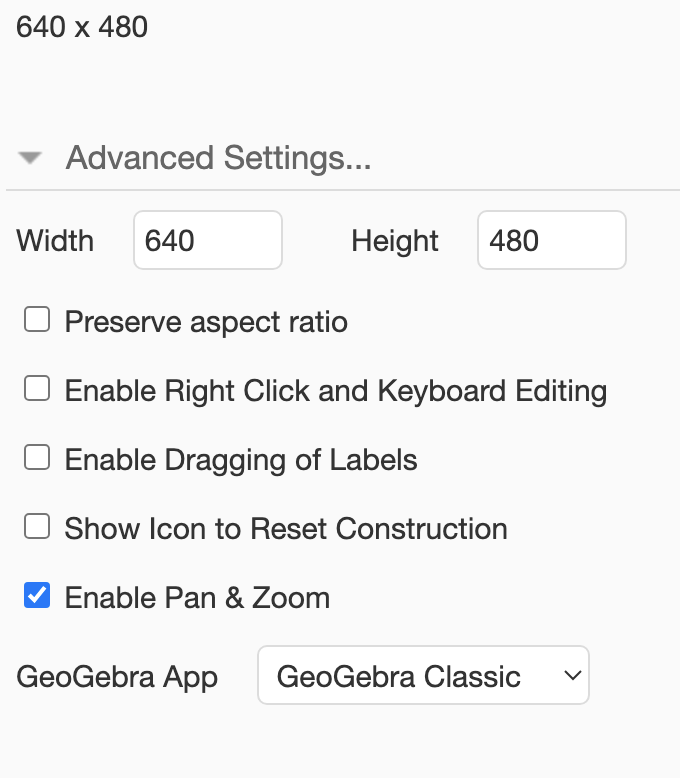
The size of the interactive should be able to fit a mobile device. I suggest 640px width and 480px height for interactives meant for the Singapore Student Learning Space (SLS). To change the dimensions, go to the page of the specific interactive you want to embed and click on the “more” button (3 dots in a vertical row). Click on “Edit Activity” as shown below. Next, click on the pencil icon to show “Advanced Settings”
Edit the width and height as required.
Click “Done” and “Save”
To get the embedding codes, go to the “more button” again (see above) and select “Details”.
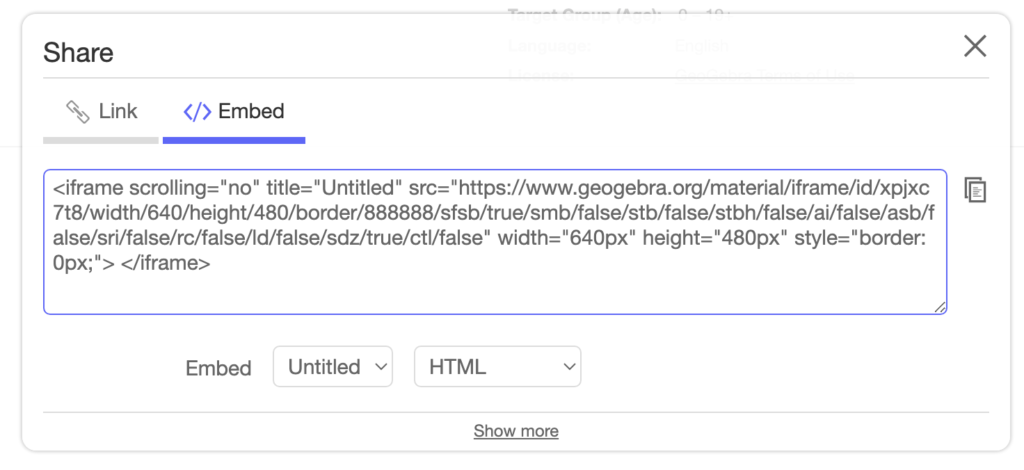
Click on “Share” and select the “</>Embed” tab.
Copy the iframe embed code and paste it into SLS or your preferred LMS.
In SLS, select “Text/Media” and “Website” to insert the code.
While preparing for a bridging class for those JAE JC1s who did not do pure physics in O-levels, I prepared an app on using a vector triangle to “solve problems for a static point mass under the action of 3 forces for 2-dimensional cases”.
For A-level students, they can be encouraged to use either the sine rule or the cosine rule to solve for magnitudes of forces instead of scale drawing, which is often unreliable.
For students who are not familiar with these rules, here is a simple summary:
Sine Rule
If you are trying to find the length of a side while knowing only two angles and one side, use sine rule:
$$\dfrac{A}{\sin{a}}=\dfrac{B}{\sin{b}}$$
Cosine Rule
If you are trying to find the length of a side while knowing only one angle and two sides, use cosine rule:
It’s Day 1 of the full home-based learning month in Singapore! As teachers all over Singapore scramble to understand the use of the myriad EdTech tools, I have finally come to settle on a few:
Google Meet to do video conferencing
Google Classroom for assignment that requires marking
Student Learning Space for students’ self-directed learning, collaborative discussion and formative assessment.
Loom for lecture recording
GeoGebra for visualisation
The following is a video that was created using Loom to explain a question on why tension in a rope on which a weight is balanced increases when the rope straightens.
Problems involving two bodies moving together usually involve asking for the magnitude of the force between the two.
For example:
A 1.0 kg and a 2.0 kg box are touching each other. A 12 N horizontal force is applied to the 2.0 kg box in order to accelerate both boxes across the floor. Ignoring friction, determine:
(a) the acceleration of the boxes, and
(b) the force acting between the boxes.
To solve for (b) requires an understanding that the free-body diagram of the 1.0 kg box can be considered independently as only the force acting between the two boxes contributes to its acceleration since it is the only force acting on it in the horizontal direction.
This interactive app allows for students to visualise the forces acting on the boxes separately as well as a single system.
The codes for embedding into SLS:
<iframe scrolling="no" title="Two Mass Problem" src="https://www.geogebra.org/material/iframe/id/fh5pwc37/width/638/height/478/border/888888/sfsb/true/smb/false/stb/false/stbh/false/ai/false/asb/false/sri/false/rc/false/ld/false/sdz/false/ctl/false" width="638px" height="478px" style="border:0px;"> </iframe>