IP4 10 Static Electricity

Electrostatic Precipitator Simulation

Open in new tab 🔗

Interact with the simulation of an electrostatic precipitator (ESP) above. The ESP is a big air cleaner for factories and power plants. It uses electricity to pull tiny dust and mist out of smoky gas before the gas goes up the stack. Inside the box are thin wires kept at a very high voltage next to large metal plates that are grounded. The high voltage makes a faint “corona” around the wires, which is a cloud of charged ions. As the dirty gas flows past, those ions bump into the dust particles and give them an electric charge, kind of like when a balloon rubs on your sweater and becomes “static.”

Once the particles are charged, the electric field pushes them sideways toward the plates. Positive particles are pulled one way, negative the other, but either way they end up sticking to a plate instead of staying in the air stream. The cleaned gas keeps moving forward and exits the ESP. Every so often, the plates are cleaned: in a dry ESP, mechanical “rappers” gently shake the plates so the dust falls into hoppers; in a wet ESP, water rinses the plates so sticky mist and very fine droplets wash off.

ESP performance depends on keeping the electric field strong and the gas flow smooth, and on the dust being “just right” electrically—if it holds charge too well or not well enough, efficiency drops. When everything is tuned properly, an ESP can remove well over 99% of particles with very little resistance to airflow. That’s why they’re widely used to protect the air around power plants, cement kilns, and other heavy industries.

Charging Two Conductors by Induction Simulation

Open in new tab 🔗

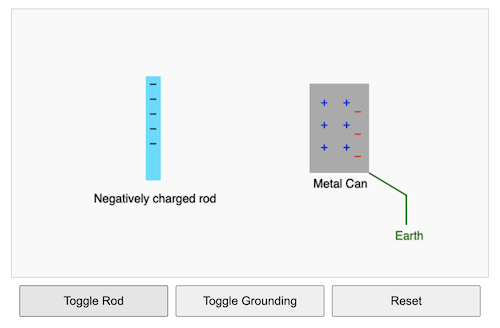
Following a previous simulation on charging by induction, this simulation allows students to investigate the effects of performing the actions of bringing or removing a charged rod near a pair of conducting cans that can be placed in contact or separated-in any order they choose. Each sequence produces a distinct outcome: the cans may finish with opposite charges or both neutral. The simulation makes the invisible electron shifts clear, helping learners see exactly when charge flows between cans and when it merely redistributes inside a single conductor.

The above screenshot shows one possible state of the charges after a particular sequence of buttons are clicked. Could you figure out what is the order of buttons pressed?

Charging by Induction Simulation

Open in new tab 🔗

In the topic of Static Electricity, charging by induction often presents a challenge for students. The process involves several invisible steps — the movement of electrons, the effect of grounding, and the lasting net charge after removing the influencing object. To bridge this gap between theory and understanding, I have created this interactive simulation to help students visualise the interactions and changes. Students can be asked to predict what will happen using various button sequences to help challenge students’ preconceptions about electric charge and behaviour during induction.

Charging by Induction Javascript Simulation

Refer to the scenario above. What will happen next if we:
a) Remove the earth wire before removing the rod, or
b) Remove the rod before removing the earth wire?

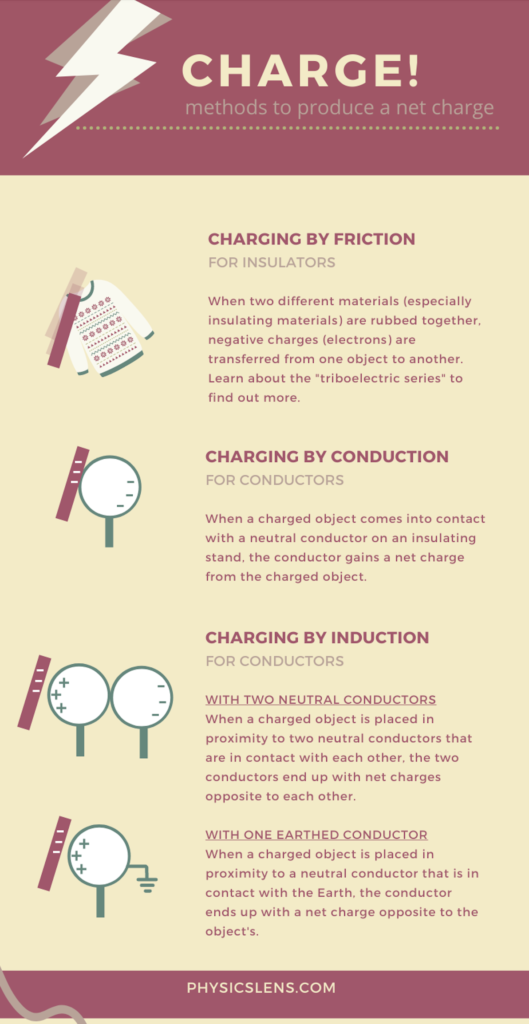
Charge! [Infographics using Canva]

I like Canva for its ease of use and beautiful templates for creating simple infographics. This is an example of one that I did to simplify the content for IP4 Static Electricity.

How to survive a lightning strike

This is an interesting question on electricity: in order to survive a lightning strike, which of the following costumes offer the best protection? A coat of armour, your birthday suit, a wetsuit or a superman costume? Watch this MinuteEarth video on Faraday’s cage to find out!

Ionisation of Air to Remove Static Electric Charges

Materials

  1. Wool
  2. PVC pipe or plastic comb
  3. String
  4. Lighter

Procedure

  1. Hang the string from an elevated position. Leave the bottom end free.
  2. Rub the PVC pipe with wool. This deposits negative charges, or electrons, onto the surface of the PVC pipe.
  3. Place the side of the pipe that is rubbed near the string. You should notice the string being attracted  towards the PVC pipe.
  4. Holding the PVC pipe still while attracting the string, light a flame using the lighter and place it in between the string and pipe. You should observe the string falling back to its original position.

Science Explained

When air is ionised with the help of a flame, it serves as a conducting medium through which static electric charges can escape from a surface.