IP3 08 General Wave Properties

Displacement-distance graph and displacement-time graph of a wave

Open in new tab 🔗

Click here for full view.

Exploring Wave Properties Through Interactive Simulations

One of the most powerful ways to learn about waves is not just by reading definitions, but by seeing them in action. This simulation allows you to adjust amplitude, frequency, wavelength, and speed and watch how the wave’s behavior changes over time and space.

By the end of this activity, you should be able to:

  1. Define and use the terms speed, frequency, wavelength, period, and amplitude, and connect them to what you see on the graphs.
  2. Recall and apply the relationship $v = f \lambda$ to new situations and solve related problems.

How to Interact With the Simulation

Two Graphs, Two Perspectives

  • The top graph (Displacement vs Distance) shows the shape of the wave along space at a single instant.
  • The bottom graph (Displacement vs Time) shows how a single particle moves up and down as time passes.

Controls

  • Use the sliders to change Amplitude, Frequency, Wave Speed, and Wavelength.
  • Press Start Animation to see the wave move. Press it again to stop.
  • Press Reset to return to default values.

What happens when you…

  • Increase Amplitude → The wave gets taller, but the speed and wavelength stay the same.
  • Increase Frequency → More oscillations appear in the same time, and the particle on the time graph moves faster up and down.
  • Change Wavelength → The distance between crests and troughs changes on the distance graph.
  • Change Speed → The wave travels faster across the distance graph.

Use these questions as you experiment with the sliders:

Amplitude

  • How does increasing amplitude affect the wave’s appearance on both graphs?
  • Does amplitude change the wave speed?

Frequency and Period

  • Observe the bottom graph: How many oscillations occur in one second when frequency is 1 Hz? What is the period (time for one cycle)?
  • What happens to the period when you double the frequency?

Wavelength

  • On the top graph, how do the positions of the crests and troughs change as you adjust the wavelength slider?
  • Can you measure one wavelength directly from the graph?

Wave Speed Relationship

  • Try setting frequency = 2 Hz and wavelength = 150 mm. What is the predicted wave speed using $v = f \lambda$
  • Now observe the simulation: Does the wave move across the distance graph at that speed?
  • Repeat for another set of values (e.g. f=0.5 Hz, λ=300 mm). Does the relationship still hold?

Connecting Both Graphs

  • Watch the red dot on the distance graph (a fixed point on the medium). How does its motion compare with the displacement–time graph?
  • Why does the red dot’s vertical motion look like a sine wave over time?
Representing a Longitudinal Wave Graphically

I modified an existing simulation to demonstrate how the displacement of particles along a longitudinal wave can be represented in graphical form.

Essentially, one would have to determine for each particle, its displacement from the equilibrium position and its corresponding position along the wave’s direction. On the graph, positive displacement indicates movement in one direction (e.g., to the right), while negative displacement indicates movement in the opposite direction (e.g., to the left).

For the full view, go to https://www.geogebra.org/m/kq3e2qjk

Graphical Representation of Waves

Use the quiz below to test your ability to interpret graphs of waves. You can click on a point in the map to read the values.

The codes for this quiz are generated by AI. However, the options and correct answers are rule-based and as such, should not have any errors.

It is able to randomly select from 4 different questions for displacement-distance graphs and 4 others for displacement-time graphs, while randomising the values of amplitude, wavelength and period.

Pressure-Distance Graph of a Sound Wave

This GeoGebra applet was modified from an existing applet to show the relationship between the pressure-distance and displacement-distance graph of a progressive longitudinal wave.

Longitudinal and Transverse Waves

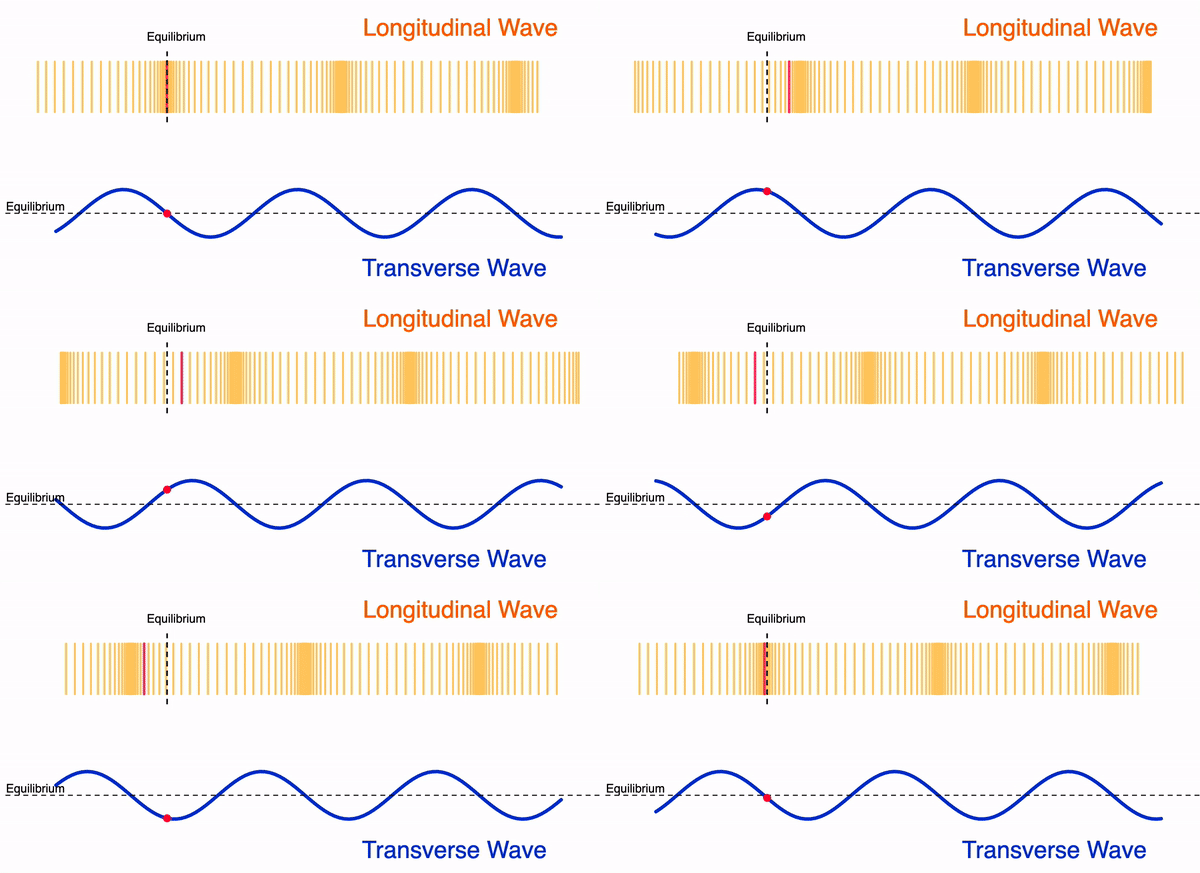
I modified Tom Walsh’s original GeoGebra app to add a moveable single oscillating particle for students to observe its movement along a longitudinal wave and a transverse wave.

The app can also be used to show how the displacement of a particle in a longitudinal wave can be mapped onto a sinusoidal function, similar to the shape of a transverse wave. For example. a displacement of the particle to the right can be represented by a positive displacement value on the displacement-distance graph.

You can choose to select the particle that you want to focus on by using the slider.

For a full screen view, visit https://www.geogebra.org/m/auyft2pd

Here is an animated gif for those who prefer to insert it into a powerpoint slideshow instead:

Animation of longitudinal wave and transverse wave

For embedding into SLS or any platform that supports iframes.

<iframe scrolling="no" title="Progressive Waves" src="https://www.geogebra.org/material/iframe/id/auyft2pd/width/640/height/480/border/888888/sfsb/true/smb/false/stb/false/stbh/false/ai/false/asb/false/sri/true/rc/false/ld/false/sdz/false/ctl/false" width="640px" height="480px" style="border:0px;"> </iframe>

Movement of Particle in a Wave

This GeoGebra app allows students to observe closely the movement of a particle in a progressive wave, with two possible directions of energy propagation.

In a typical question, students will be asked to predict the next movement of a particle given that a wave is moving left or right. Usually, students will need to imagine the waveform shifting slightly to the left or right in order to figure that out. This app follows the same visualisation technique to identify the subsequent movement of any particle along a wave.