A-level Topics

3D view of forces on parallel currents using GeoGebra

Open in new tab 🔗

The simulation serves to show how the magnetic field of one current-carrying wire exerts a force on another current-carrying wire.

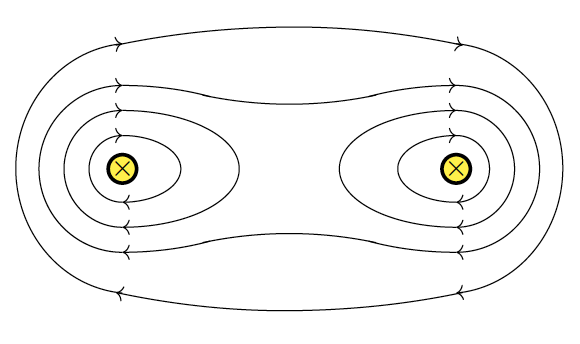
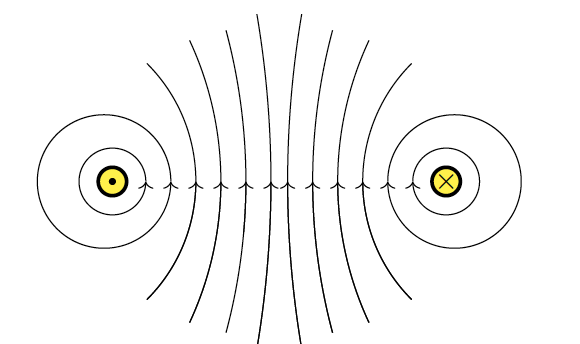
When two wires are placed parallel to each other and carry electric currents, each wire produces its own magnetic field. The magnetic field around a straight current-carrying conductor forms concentric circles, and the direction of these circles can be determined by the right-hand grip rule: if you point your thumb along the direction of the current, your curled fingers show the direction of the magnetic field lines.

Because of this, one wire is always sitting inside the magnetic field created by the other. The moving charges in the second wire—that is, the current—interact with this magnetic field and experience a force. The strength of the force depends on the current in both wires and the distance between them, while the direction of the force can be worked out using Fleming’s left-hand rule or simply by considering how the two fields interact.

Magnetic field patterns between two parallel currents interact in such a way as to form either an attraction (for currents in same direction) or a repulsion (for opposite currents)

If the currents in the two wires flow in the same direction, the magnetic fields between the wires reinforce each other, producing a stronger field outside the pair and a weaker field between them. This imbalance pulls the wires towards each other, so they attract. On the other hand, if the currents run in opposite directions, the magnetic fields between the wires reinforce instead, while the fields outside are weakened. The result is a pushing apart of the two wires, so they repel each other.

In short, the force on parallel wires arises because each wire generates a magnetic field that acts on the current in the other. Identifying the force is straightforward once you know the directions of the currents: currents in the same direction cause attraction, while currents in opposite directions cause repulsion.

Temperature and Pressure of Gas

This interactive HTML5 simulation models the behavior of gas particles in a fixed-volume container, allowing users to explore the relationships between temperature, pressure, and particle motion. Users can adjust the temperature using a slider, which directly affects the speed of the particles based on kinetic theory. As particles collide with the container walls, they briefly turn red to visually indicate wall interactions—collisions that contribute to pressure. A real-time pressure gauge on the side rises proportionally with temperature, consistent with the ideal gas law.

Open in new tab 🔗
500 K

According to the kinetic model of matter, gases consist of a large number of small particles (atoms or molecules) moving randomly and continuously in all directions. These particles have kinetic energy, which depends on temperature.

As temperature increases, the average kinetic energy of the gas particles increases. This means the particles move faster. Since pressure arises from particles colliding with the walls of the container, faster-moving particles collide more frequently and with greater force. These more energetic collisions result in a higher pressure on the container walls.

In a fixed volume, this explains why pressure is directly proportional to temperature (in kelvin), a relationship described by: $$ P \propto T $$
(if volume and number of particles are constant)

AC Generator Simulator

Open in new tab 🔗

An AC generator, or alternator, is a device that converts mechanical energy into electrical energy by means of electromagnetic induction. At its core, the generator consists of a coil of wire that is made to rotate within a magnetic field. This magnetic field is usually produced by permanent magnets or electromagnets positioned so that their field lines pass through the area enclosed by the coil.

As the coil rotates, it cuts through the magnetic field lines. This motion causes the magnetic flux linkage through the coil to change over time. According to Faraday’s Law of Electromagnetic Induction, whenever there is a change in magnetic flux linkage through a circuit, an electromotive force (emf) is induced in the circuit. The faster the coil rotates or the stronger the magnetic field, the greater the rate of change of flux, and thus, the greater the induced emf.

The rotation causes the magnetic flux to vary in a sinusoidal manner, leading to an emf that also varies sinusoidally. This means the direction of the induced current reverses every half-turn, producing an alternating current (AC). The expression for the induced emf is typically given by: $\epsilon(t)=NBA\omega \sin⁡( \omega t)$

where $N$ is the number of turns in the coil, $B$ is the magnetic flux density, $A$ is the area of the coil, $\omega$ is the angular velocity of rotation, and $t$ is time.

To extract the current from the spinning coil without tangling wires, slip rings are connected to the ends of the coil. These rotate with the coil and maintain contact with carbon brushes, which allow the generated current to flow into an external circuit.

In essence, an AC generator works by continually rotating a coil within a magnetic field, causing a periodic change in magnetic flux that induces an alternating voltage. This principle is the foundation of electricity generation in power stations around the world.

Faraday’s Experiment Simulation

Open in new tab 🔗

In Faraday’s experiment, moving a magnet into or out of a coil induces an electric current, which is detected by a galvanometer. The faster the magnet moves, the greater the deflection of the needle. The direction of needle deflection depends on whether the magnet is moving toward or away from the coil—reversing as the direction of motion changes. When the magnet is stationary, the needle returns to the center, indicating no induced current.

This simulation allows the user to explore the laws of electromagnetic induction (Faraday and Lenz) by dragging a magnet into and away from a coil.

Fleming’s left-hand rule vs right-hand palm rule

Fleming’s Left-Hand Rule and the Right-Hand Palm Rule are visual tools used to predict directions in electromagnetic interactions.

Fleming’s Left-Hand Rule applies to electric motors and helps determine the direction of the force (motion) on a current-carrying conductor placed in a magnetic field. By aligning the thumb (force, $F$), first finger (magnetic field, $B$), and second finger (current, $I$) at right angles, one can deduce the force direction.

The Right-Hand Palm Rule serves the same purpose, but might actually be more intuitive, as the fingers would look like parallel vectors in a uniform magnetic field. The thumb points in the direction of the current. The hand will then naturally look like it is exerting a push in the direction of the palm.

I like to joke with my class that both serve the same purpose but one resembles a gun while the other resembles a kungfu move. Which would you prefer?

Side note: The image above is generated using a single prompt with ChatGPT 4o: “draw an image representing fleming’s left hand rule, next to the right-hand palm rule.” I’m impressed by how far AI image generation has come.

Simulation of Projectile Motion with Air Resistance

Open in new tab 🔗 This simulation offers a hands-on and dynamic way to explore the physics of projectile motion with and without air resistance. By adjusting parameters such as launch velocity, angle, and air resistance, users can visualize how these factors affect the shape and reach of a projectile’s trajectory. The app provides real-time changes including motion paths, velocity vectors, and a velocity-time graph showing horizontal and vertical components separately. It also calculates and displays key quantities such as maximum height and range under ideal and non-ideal conditions (based on an arbitrary coefficient of drag. Through interactive experimentation and visual reinforcement, learners gain a deeper understanding of concepts the effect of air resistance, and the difference between theoretical and real-world motion. This is suitable for JC1’s topic on projectile motion. It can also be used for Upper Sec, if you change the launch angle to 90 degrees.