03 Motion and Forces

Newton’s 2nd Law Applet

For a full-screen view, click here.

<iframe scrolling="no" title="Dynamics Problem" src="https://www.geogebra.org/material/iframe/id/uthszwjq/width/640/height/480/border/888888/sfsb/true/smb/false/stb/false/stbh/false/ai/false/asb/false/sri/false/rc/false/ld/false/sdz/true/ctl/false" width="640px" height="480px" style="border:0px;"> </iframe>

This applet was designed with simple interactive features to adjust two opposing forces along the horizontal direction in order to demonstrate the effect on acceleration and velocity.
Equation of Motion App

Access the app in full screen here: https://www.geogebra.org/m/mfvvhjrj

This app is designed to give students practice in interpreting velocity-time graphs with various scenarios, such as more complex examples involving negative velocity and acceleration. Answers will be given if student is wrong.

Use this to embed into SLS or another LMS.

<iframe scrolling="no" title="Equations of Motion" src="https://www.geogebra.org/material/iframe/id/mfvvhjrj/width/700/height/480/border/888888/sfsb/true/smb/false/stb/false/stbh/false/ai/false/asb/false/sri/false/rc/false/ld/false/sdz/false/ctl/false" width="700px" height="480px" style="border:0px;"> </iframe>

Bouncing Ball Animation using Python

For a fullscreen view, visit https://www.glowscript.org/#/user/wboson2007/folder/MyPrograms/program/Bouncing

Modified this python simulation from Dr Darren Tan’s work at https://sciencesamurai.trinket.io/a-level-physics-programming#/collisions/bouncing-ball

Wanted to try out a different way of creating simulations. Added the acceleration-time graph in place of his energy-time graph, in preparation for the teaching of kinematics. Also assuming no energy loss during collisions for simplicity.

For Singapore teachers, I have submitted a request to SLS for this URL to be whitelisted for embedding. Once approved, glowscript simulations can be embedded as part of the lesson. For the time being, a URL link out to the simulation will have to do.

Multiple Representation of Vertical Throw

One common misconception among new learners of kinematics is that acceleration of an object being thrown upward is zero at the top of the path when it is momentarily at rest. I created this interactive, along with the 3 graphs in order to help students relate the vectors to the graphical representation of motion.

It is also worth noting that students often have conflicting ideas of the acceleration at the beginning of the throw, as they are aware that a resultant upward acceleration is necessary for the object to start moving upward in the first place. Hence, it must be stressed that the animation begins after the ball has left the throwing hand.

For a view that is optimized for your screen, visit https://www.geogebra.org/m/zvsydy9f.

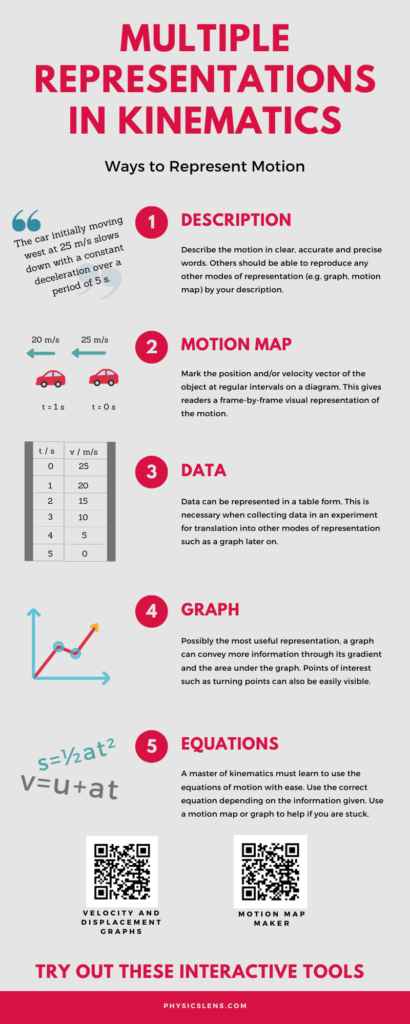
Multiple Representation in Kinematics

This is another Infographic made using Canva last year.

Pendulum-Powered Car

This pendulum-powered car is constructed using Lego Technic parts. I used mainly Lego beams to create the chassis and an “A” frame from which the pendulum is suspended. The pendulum is made of Lego beams and some wheels.

When the pendulum swings, it experiences an acceleration towards its equilibrium position. By the principle of conservation of momentum, the car experiences a change in momentum in the opposite direction. Since the acceleration of the pendulum changes its direction every half a cycle of its oscillation, the car will only oscillate about its original position if the wheels of the car are free to turn throughout the oscillation. 

A escapement mechanism which consists of a beam resting on a pair of 40-tooth gears attached to the front wheels prevent the wheels from rotating in the opposite direction. This means that the car will only be moving forward during the half of the pendulum’s oscillation when its displacement is at the front of its equilibrium position and pauses during the other half.