A-level Topics

Angular displacement

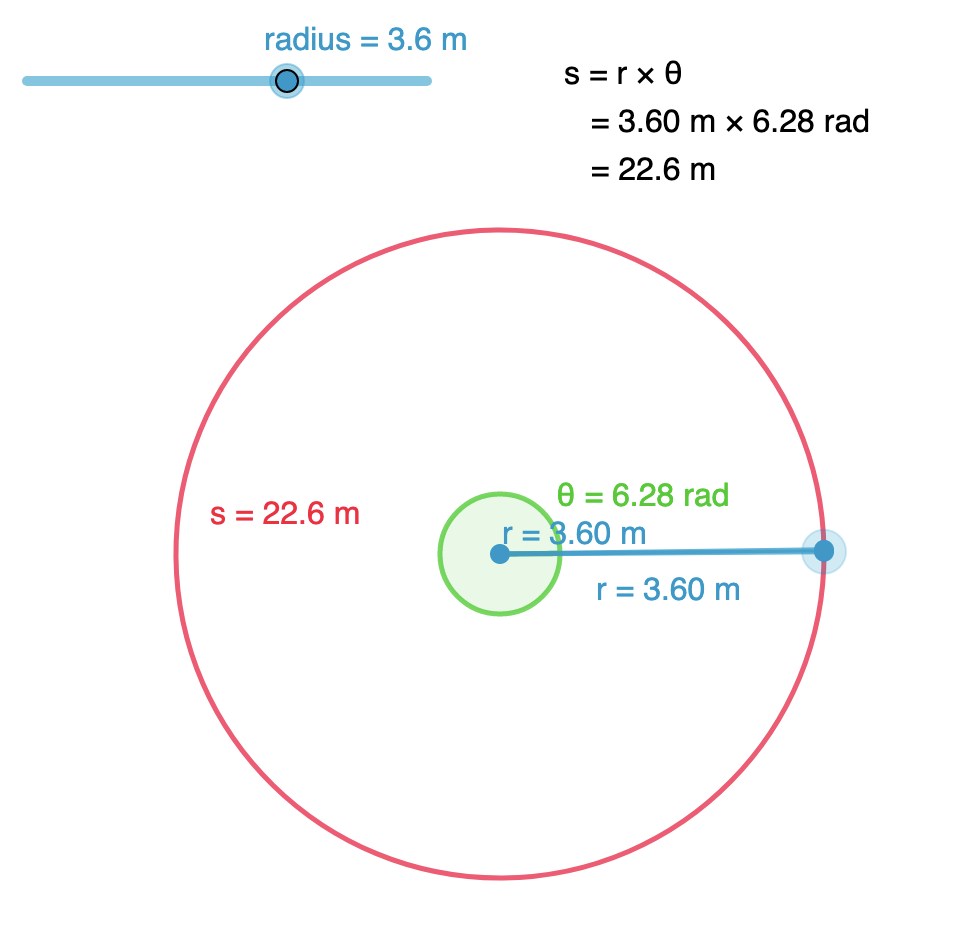
This GeoGebra app shows the relationship s = .

One activity I get students can do is to look at the value of θ when the arc length s is equal to the radius r. This would give the definition of the radian, which is the angle subtended at the centre of a circle by an arc equal in length to its radius.

Mathematics defines the constant π as the ratio of a circle’s circumference to its diameter. This can also be shown in the app, although you need to drag the moving point to a point just short of one full revolution.
Using Google Spreadsheet to obtain best-fit line

I am taking the opportunity (since my students are all doing home-based learning) to teach them how to use spreadsheets to do calculations and to obtain a best-fit line. While they can still submit graph work using PDF scanning apps such as Office Lens and Camscanner into Google Classroom for me to mark, they can make use of the spreadsheet-generated graph to check their results.

Even though for exams, we still require them to plot the points on paper and obtain the gradient and intercept from points on the best-fit line, nobody is going to do so when they start working. So I might as well teach them now.

Due to the lack of face-to-face time, I made this step-by-step video showing them how to do so.

Best-fit Line

For lab work, students often have to estimate a line of best fit for their data points manually. It takes a bit of practice to get it right. With this app, students can generate data points with varying types of scatter and predict their own best-fit line before comparing it with a computer generated one based on the least mean square method.

Forces in Equilibrium

While preparing for a bridging class for those JAE JC1s who did not do pure physics in O-levels, I prepared an app on using a vector triangle to “solve problems for a static point mass under the action of 3 forces for 2-dimensional cases”.

For A-level students, they can be encouraged to use either the sine rule or the cosine rule to solve for magnitudes of forces instead of scale drawing, which is often unreliable.

For students who are not familiar with these rules, here is a simple summary:

Sine Rule

If you are trying to find the length of a side while knowing only two angles and one side, use sine rule:

$$\dfrac{A}{\sin{a}}=\dfrac{B}{\sin{b}}$$

Cosine Rule

If you are trying to find the length of a side while knowing only one angle and two sides, use cosine rule:

$$A^2 = B^2 + C^2 – 2BC\cos{a}$$

Forces on a ladder on a wall

A ladder rests on rough ground and leans against a rough wall. Its weight W acts through the centre of gravity G. Forces also act on the ladder at P and Q. These forces are P and Q respectively.

Which vector triangle represents the forces on the ladder?

Using Loom and GeoGebra to explain a tutorial question

It’s Day 1 of the full home-based learning month in Singapore! As teachers all over Singapore scramble to understand the use of the myriad EdTech tools, I have finally come to settle on a few:

  1. Google Meet to do video conferencing
  2. Google Classroom for assignment that requires marking
  3. Student Learning Space for students’ self-directed learning, collaborative discussion and formative assessment.
  4. Loom for lecture recording
  5. GeoGebra for visualisation

The following is a video that was created using Loom to explain a question on why tension in a rope on which a weight is balanced increases when the rope straightens.