Seng Kwang Tan

Root-mean-square Currents

The concept of root-mean-square values for Alternating Currents is challenging if students are to relate the I-t graph with the Irms value directly.

They have to be brought through the 3 steps before arriving at the Irms value. This interactive applet allows them to go through step by step and compare several graphs at one time to see the relationship.

Through the interaction, students might be asked to observe that the Irms value is never higher than the peak Io.

For a complete sinusoidal current:

For a diode-rectified current:

In comparing the Irms of both currents, students can be asked to consider why the ratio of the values is not 2:1 or any other value, from energy considerations.

Worked on this earlier as I am the lead lecturer for this JC2 topic and am trying to integrate useful elements of blended learning. Do let me know in the comments if you have ideas or feedback that you would like to share.
Pressure-Distance Graph of a Sound Wave

This GeoGebra applet was modified from an existing applet to show the relationship between the pressure-distance and displacement-distance graph of a progressive longitudinal wave.

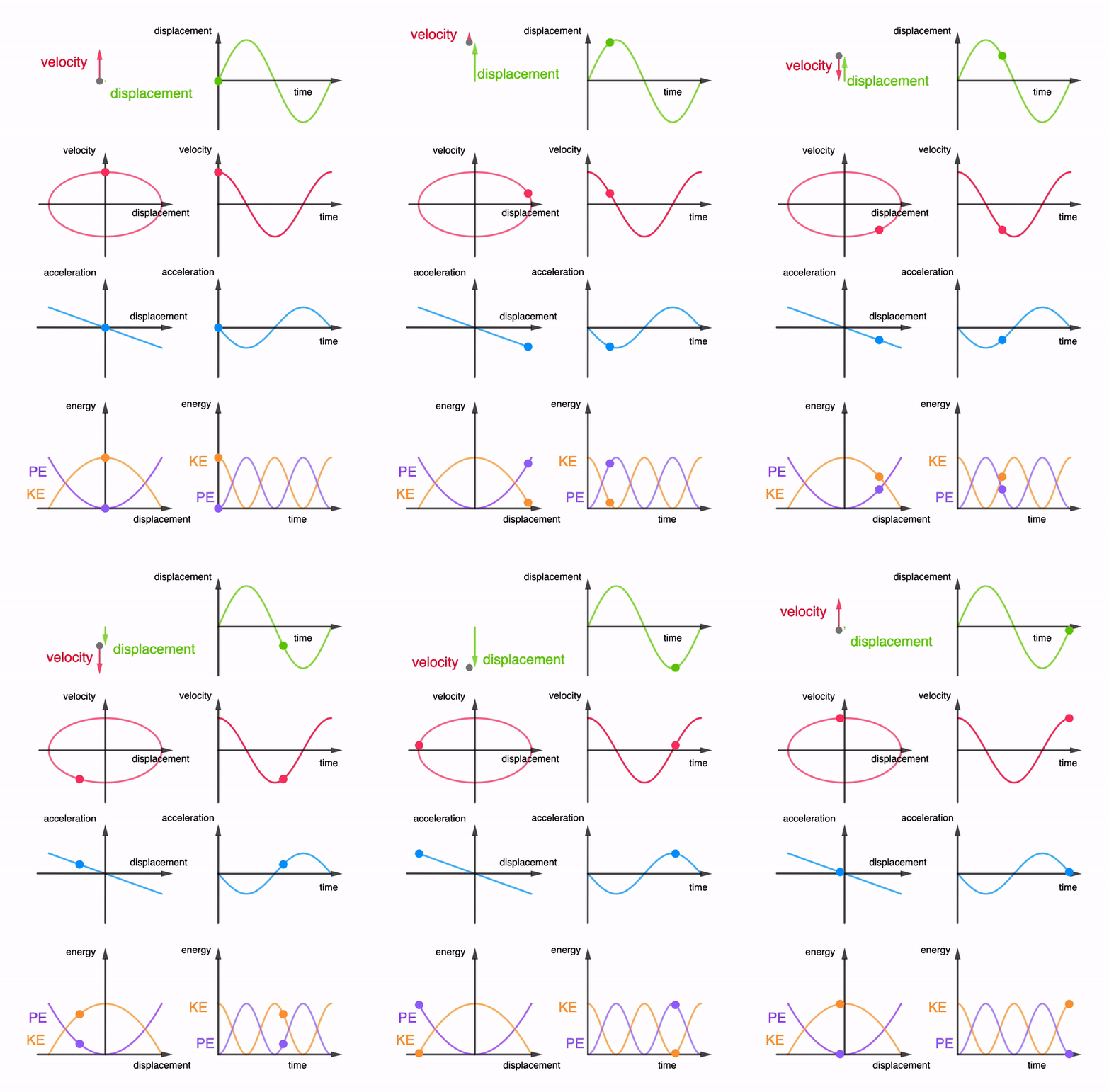
Simple harmonic motion graphs including energy

I have added two more graphs into the interactive animation. However, the app has become a bit sluggish when changing the period or amplitude. It still works smoothly when viewing the animation.

Students ought to find it useful to look at all the graphs together instead of in silo. This way, they can better understand the relationships between the graphs.

Here is an animated gif for use on powerpoint slides etc.

simple harmonic motion graphs

Simple Harmonic Motion Graphs

Here’s my attempt at animating 5 graphs for simple harmonic motion together in one page.

From left column:

$$v = \pm\omega\sqrt{x_o^2-x^2}$$

$$a = -\omega^2x$$

From right column:

$$s = x_o\sin(\omega t)$$

$$v = x_o\omega \cos(\omega t)$$

$$a = -x_o\omega^2 \sin(\omega t)$$

And here is the animated gif file for powerpoint users:

Simple harmonic motion graphs - displacement-, velocity-, acceleration- time graphs and more

Invisible Spheres using Hydrogel

I used this demonstration to start a conversation about refractive index with my IP3 kids. These hydrogels certainly generated a lot of excitement as the kids were fascinated with how invisible it becomes when placed in water.

You can get a 1000 (yes, one thousand!) of these for $1.29 at Shopee. Make sure to choose the transparent ones instead of the coloured version when checking out.

Say goodbye to the messy demonstration involving the soaking of glass in a beaker of vegetable oil or glycerin.

Magdeburg Hemispheres

As promised, I am sharing another purchase made during this mid-term break for my kids.

Magdeburg hemispheres are used to demonstrate the power of atmospheric pressure. This simple demonstration kit consists of two plastic hemispheres, a rubber ring, a one-way valve, a syringe and some rubber tubing.

First, the one-way valve and the syringe are attached to the hemisphere that has a nozzle.

The two hemispheres are then placed together with the rubber ring between them. The rubber ring will serve as a seal as the hemispheres press against it when the air is pumped out.

As the syringe is pulled, the pressure inside the sphere decreases. This results in the atmospheric pressure being significantly larger than the internal pressure and thus, the hemispheres can not be pulled apart by hand.

To separate the hemispheres, remove the tubing and the hemispheres will simply fall apart as the internal pressure rises and reaches an equilibrium with atmospheric pressure.

The kit can be bought for less than S$3 here. There are other sellers that seem to offer lower prices, which I realised while doing a search for the keywords “Magdeburg Hemispheres” only after making the purchase because I was thinking it could not get any lower.