Teaching Resources

Physics teaching resources

Diamagnetism

I didn’t want to spend money on buying a piece of pyrolytic graphite and large neodymium magnets so I made do with what I have to make the following video. While diamagnetism is not in the A-level physics syllabus, it’s good for students to know that there are other classifications of magnetic materials.

What we study in our syllabus is ferromagnetism, which is exhibited by materials such as iron, cobalt and nickel. Some pencil leads are paramagnetic (weakly attracted to magnets) while others such as the one in the video are diamagnetic (repelled by magnets).

I bought my neodymium magnets from DX.com and the shipping to Singapore takes about 3 weeks, so you might want to factor that time in if you want to get some for your lessons. These magnets are great for other demonstrations such as homopolar motors and Newton’s nightmare.

Introducing Delight! An Educational Board Game on Current Electricity

Delight - Physics board game on electricity

Download Now

Creative Commons License
Delight by Tan Seng Kwang is licensed under a Creative Commons Attribution-NonCommercial-ShareAlike 3.0 Unported License.

An educational board game for 2 or any even number of players (in 2 teams) based on the concepts of current electricity. Targeted at high school / junior college physics students, Delight is a fun way of practising the use of physics concepts such as

  1. electrical power $$P=\frac{V^2}{R}$$
  2. the potential divider rule.
  3. wires bypassing a device short-circuits it.

This game can be easily printed on A4 paper and the game pieces can be cut up for use.

Game Play

  1. This game is meant for 2 players or 2 teams of players. Each player/team has the following tiles:
    • 2 x light bulbs
    • 3 x T-shaped wires
    • 2 x crossed wires
  2. The players will take turns to place the tiles on the board.
  3. Each new tile must have at least one wire connected to an existing wire on the board.
  4. The game will end when the last tile has been placed on the board.
  5. The person with the brightest bulb will win.In the event that there is an equal number of opposing bulbs of the same brightness, it will be considered a tie. If there are three bulbs of the same brightness, the one with two of these bulbs wins.

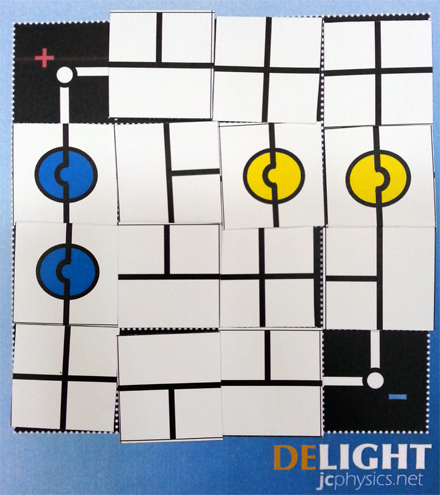
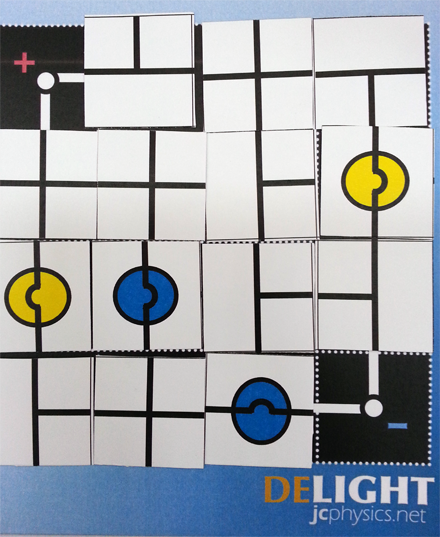
Test Yourself: Who is the winner for the games below?

GAME 1

delightend

GAME 2

gameplay2


Conditions for Using this Game

  1. Anyone can print and use this game for free as long as it is for educational or personal use. Any other reproduction or republishing of this material, in hard copy or electronic form, without written permission, is prohibited.
  2. If you would like to make a suggestion or an enquiry, please leave a comment below.

Displacement, Velocity and Acceleration of Bouncing Ball using Datalogger

A video tutorial on the use of the Addestation datalogger with its motion sensor to measure the displacement of a bouncing ball and to observe the velocity and acceleration using its differentiation function.

Using a datalogger to measure induced emf

This video tutorial is a guide for next week’s practical for CG18/12.

P-N Junction

The following is the transcript for a video that I will be making to explain how a P-N junction works.

A p-n junction, as the name suggests, is the boundary between two types of semiconductors: P-type and N-type.

For an intrinsic or pure semiconductor such as silicon which has 4 valence electrons, each atom is bond to 4 other neighbouring atoms.
The p-type semiconductor is one with excess holes due to the addition of dopants to intrinsic semiconductors. Elements such as boron or phosphorus from Group III of the periodic table all contain three valence electrons, causing them to function as acceptors when used to dope silicon. When an acceptor atom replaces a silicon atom in the crystal, a vacant state ( an electron “hole”) is created, which can move around the lattice and functions as a charge carrier.

The n-type semiconductor is one doped with Group V elements which have five valence electrons, allowing them to act as a donor; substitution of these atoms for silicon creates an extra free electron. Therefore, a silicon crystal doped with boron creates a p-type semiconductor whereas one doped with phosphorus results in an n-type material.

When the two types of semiconductors are put together, electrons diffuse across the boundary to combine with holes, creating a depletion region where there are no charge carriers. An electric field is also set up in the depletion region because the group III atoms are now negatively charged, having gained one more electron and the group V atoms are now positively charged, having each lost an electron. This electric field prevents further charges from diffusing across the boundary.

That is, until a potential difference is applied. The p-n junction serves now as a diode. We shall illustrate this with a single cell attached to the device. In the reverse-biased mode, the positive terminal is connected to the n-type semiconductor while the negative terminal is connected to the p-type end. This causes more electrons to move away from the depletion region in the n-type semiconductor and for more holes to be filled in the p-type semiconductor. The result is a widened depletion region and a larger opposing electric field.

In the forward-biased mode, the positive terminal of the cell is connected to the p-type semiconductor while the negative terminal is connected to the n-type end. The potential difference provided offers the electrons in the n-type semiconductor a push to overcome the small electric field formed across the depletion region and flow across to the p-type semiconductor which it then passes from hole to hole into the positive terminal.