IP4 15 Electromagnetism

3D view of forces on parallel currents using GeoGebra

Open in new tab đź”—

The simulation serves to show how the magnetic field of one current-carrying wire exerts a force on another current-carrying wire.

When two wires are placed parallel to each other and carry electric currents, each wire produces its own magnetic field. The magnetic field around a straight current-carrying conductor forms concentric circles, and the direction of these circles can be determined by the right-hand grip rule: if you point your thumb along the direction of the current, your curled fingers show the direction of the magnetic field lines.

Because of this, one wire is always sitting inside the magnetic field created by the other. The moving charges in the second wire—that is, the current—interact with this magnetic field and experience a force. The strength of the force depends on the current in both wires and the distance between them, while the direction of the force can be worked out using Fleming’s left-hand rule or simply by considering how the two fields interact.
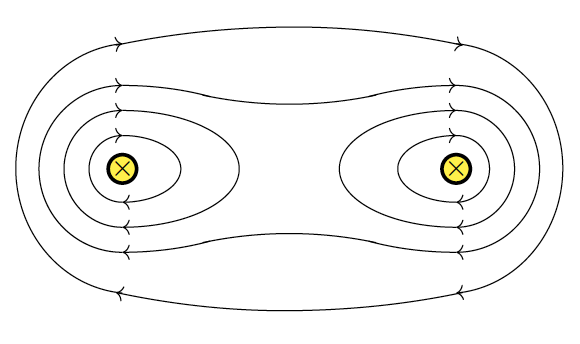
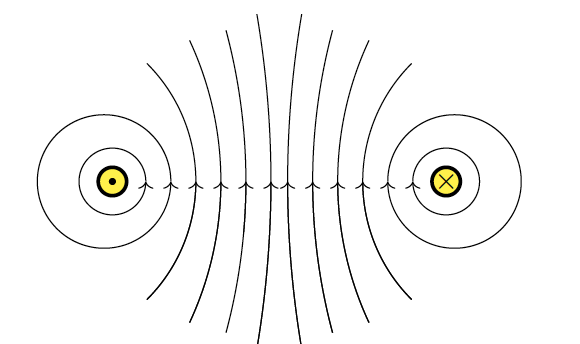
Magnetic field patterns between two parallel currents interact in such a way as to form either an attraction (for currents in same direction) or a repulsion (for opposite currents)

If the currents in the two wires flow in the same direction, the magnetic fields between the wires reinforce each other, producing a stronger field outside the pair and a weaker field between them. This imbalance pulls the wires towards each other, so they attract. On the other hand, if the currents run in opposite directions, the magnetic fields between the wires reinforce instead, while the fields outside are weakened. The result is a pushing apart of the two wires, so they repel each other.

In short, the force on parallel wires arises because each wire generates a magnetic field that acts on the current in the other. Identifying the force is straightforward once you know the directions of the currents: currents in the same direction cause attraction, while currents in opposite directions cause repulsion.

Videos on Electromagnetism

This is a post that exists simply to park the YouTube videos that I might need to use during a JC2 lecture on Electromagnetism.

Homopolar Motor 2

This video demonstrates how a simple homopolar motor is made using a screw and a small neodymium magnet. The simplest possible motor one can make, it can be used to teach concepts at various levels. For lower secondary students, they can learn about conversion of energy forms while upper secondary students can learn about magnetic forces and Fleming’s left-hand rule.

Materials

  1. 10 cm wire
  2. 1.5 V battery
  3. iron screw
  4. neodymium magnet

Procedure

  1. Attach the neodymium magnet to the head of the screw.
  2. Attach the tip of the screw to one end of the battery such that the screw hangs below the battery. The screw will remain attached to the battery as the magnetic force from the neodymium holds them together.
  3. Hold one end of the wire on the top terminal of the battery and allow the other end of the wire to touch the side of the screw or the magnet. Watch the screw spin.

(Link: Alternative design for the homopolar motor)

Electromagnet

Materials

  1. Insulated wire (about 1 m in length)
  2. Iron nail (at least 5 cm in length)
  3. 1.5 V battery
  4. Adhesive tape
  5. Small metal paper clip

Procedure

  1. Test that the iron nail is not already magnetised by trying to pick up the metal paper clip with it.
  2. Strip the two ends of the wire off its insulation. Leave about 1 cm bare on each end.
  3. Coil the wire around the iron nail, pushing each coil tightly together, to make a solenoid. Make sure you leave about 5 cm free at each end of the wire in order to connect the battery to the solenoid.
  4. If there is excess wire, make a second layer of coils around the first layer.
  5. Connect the ends of the wire to the terminals of the battery.
  6. Test the solenoid now by picking up the paper clip.

Oersted’s Experiment

Hans Christian Oersted showed that an electric current can affect a compass needle in 1820. This confirms the direct relationship between electricity and magnetism, which in turn, paved the way for further understanding of the two. The direction of the magnetic field can be changed by flipping the wire around, which suggests that the direction of the magnetic field is dependent on the direction of current flow.

Materials

  1. 1.5V Battery
  2. Wire
  3. Compass

Procedure

  1. Place the compass on a horizontal surface.
  2. Connect the wire to both ends of the battery.
  3. Place the middle of the wire directly over the compass, parallel to the initial orientation of the needle.
  4. Observe the needle deflect to one direction.
  5. Now flip the wire over so the current flows in the opposite direction and place it over the compass again.
  6. The needle will deflect in the other direction.
  7. Additionally, you can place the compass on top of the wire now.

Science Explained

A current will carry with it its own magnetic field. The magnetic field lines form concentric circles around the wire so that the field points in one direction above the wire and the opposite direction below the wire. Using the right-hand grip rule, where one holds his hands as though he is gripping something with his thumb pointing in the direction of current flow, his fingers will curl in a way as to indicate the direction of the magnetic field. This is also the direction in which the needle deflects.