A-level Topics

Micrometer Screw Gauge – Self-Practice GeoGebra Applet

After completing the vernier calipers applet, I simply had to do a similar one for the micrometer. However, this was a lot more complex as the thimble’s numbers are supposed to be “rotating” rather than moving linearly. A lateral movement of the thimble had to be coupled with a vertical movement of the rotating scale, with the corresponding numbers on the scale constantly changing with each new problem.

Students will need to make readings when the spindle is closed and when open to measure an object before subtracting the zero error and keying in the answer for the actual measurement. The answer will be checked for accuracy, although not for the correct number of decimal places because I have not figured out a way to programme that check yet.

To access the applet in fullscreen, go to https://www.geogebra.org/m/qedrwymk. To embed into SLS, you may use this code:

<iframe scrolling="no" title="Micrometer with zero error" src="https://www.geogebra.org/material/iframe/id/qedrwymk/width/640/height/480/border/888888/sfsb/true/smb/false/stb/false/stbh/false/ai/false/asb/false/sri/false/rc/false/ld/false/sdz/false/ctl/false" width="640px" height="480px" style="border:0px;"> </iframe>
Vernier Calipers – Self-Practice GeoGebra Applet

The aim of this applet is to help students who just learnt about zero errors in vernier calipers to get some practice of their own. Students just have to key in their answer into the textbox and they will know if they got it correct.

To modify later: an option to give the correct answer if the student asks for it.

I have not figured out how to ensure that the input is expressed in 2 decimal places, so if any expert is able to advise, I will be glad to try it out.

To access the applet in fullscreen, go to https://www.geogebra.org/m/jybrnwgp. Meanwhile, the applet is embeddable in SLS using the following iframe code.

<iframe scrolling="no" title="Vernier calipers with zero error" src="https://www.geogebra.org/material/iframe/id/jybrnwgp/width/640/height/480/border/888888/sfsb/true/smb/false/stb/false/stbh/false/ai/false/asb/false/sri/false/rc/false/ld/false/sdz/false/ctl/false" width="640px" height="480px" style="border:0px;"> </iframe>

Credits to Abdul Latiff for the original applet which I modified to add the zero error readings.

Calculating Energy Change in Nuclear Reactions

There are two methods of calculating the energy released in a nuclear reaction, which will be demonstrated using an example. Consider the nuclear reaction:

$$^2_1H + ^3_1H \rightarrow ^4_2He + ^1_0n$$

The table below shows the values of mass and binding energy per nucleon.

binding energy per nucleon / MeVmass / u
$^2_1H$ deuterium1.11228652.0141018
$^3_1H$ tritrium2.82727373.0160493
$^4_2He$ helium7.07391834.0026032
$^1_0n$ neutron 1.0086649

Method 1: Calculate difference in mass $\Delta m$ and take $E = \Delta m c^2$

$\Delta m$ = 2.0141018 + 3.0160493 – 4.0026032 – 1.0086649 = 0.0188830 u

$E = \Delta m c^2$
= 0.0188830 × 1.66054 × 10-27 kg × (2.99792 × 108 m s-1)2
= 2.8181 × 10¹² J
= 17.589 MeV

Method 2: Calculate difference in binding energy

Changing in B.E. = B.E. of $^4_2He$ – (B.E. of $^2_1H$ + B.E. of $^3_1H$)
= 4(7.0739183) MeV – [2(1.1122865) + 3(2.8272737)] MeV
= 17.589 MeV

Harmonics of Open and Closed Pipes

The following GeoGebra interactives demonstrate the first few harmonics of an open pipe and a closed pipe given a fixed velocity of sound (340m/s). The frequencies and wavelengths are auto-calculated. Length of the pipe can be varied. Feel free to use, copy or edit them.

Open Pipe

Source: https://www.geogebra.org/m/tsufws72

For embedding into SLS or other websites:

<iframe scrolling="no" title="Harmonics of Open Pipes" src="https://www.geogebra.org/material/iframe/id/tmeypwgx/width/700/height/500/border/888888/sfsb/true/smb/false/stb/false/stbh/false/ai/false/asb/false/sri/false/rc/false/ld/false/sdz/false/ctl/false" width="700px" height="500px" style="border:0px;"> </iframe>

Closed Pipe

Source: https://www.geogebra.org/m/m3p7hny5

For embedding into SLS or other websites:

<iframe scrolling="no" title="Harmonics for Closed Pipe" src="https://www.geogebra.org/material/iframe/id/gm9k6hkg/width/700/height/500/border/888888/sfsb/true/smb/false/stb/false/stbh/false/ai/false/asb/false/sri/false/rc/false/ld/false/sdz/false/ctl/false" width="700px" height="500px" style="border:0px;"> </iframe>

Equilibrium of a Wall Shelf

This GeoGebra interactive allows students to vary the position of the centre of gravity of a shelf in order to observe the changes of the other two force vectors. The position of the supporting cable can be adjusted too.

The ability to resolve vectors allows students to apply principle of moments to understand how the vertical components of each force vary.

This is meant for the JC1 topic of Forces.

To embed into SLS, you can use the following code:

<iframe scrolling="no" title="Equilibrium of a Wall Shelf" src="https://www.geogebra.org/material/iframe/id/xdbr7qr5/width/700/height/500/border/888888/sfsb/true/smb/false/stb/false/stbh/false/ai/false/asb/false/sri/false/rc/false/ld/false/sdz/false/ctl/false" width="700px" height="500px" style="border:0px;"> </iframe>

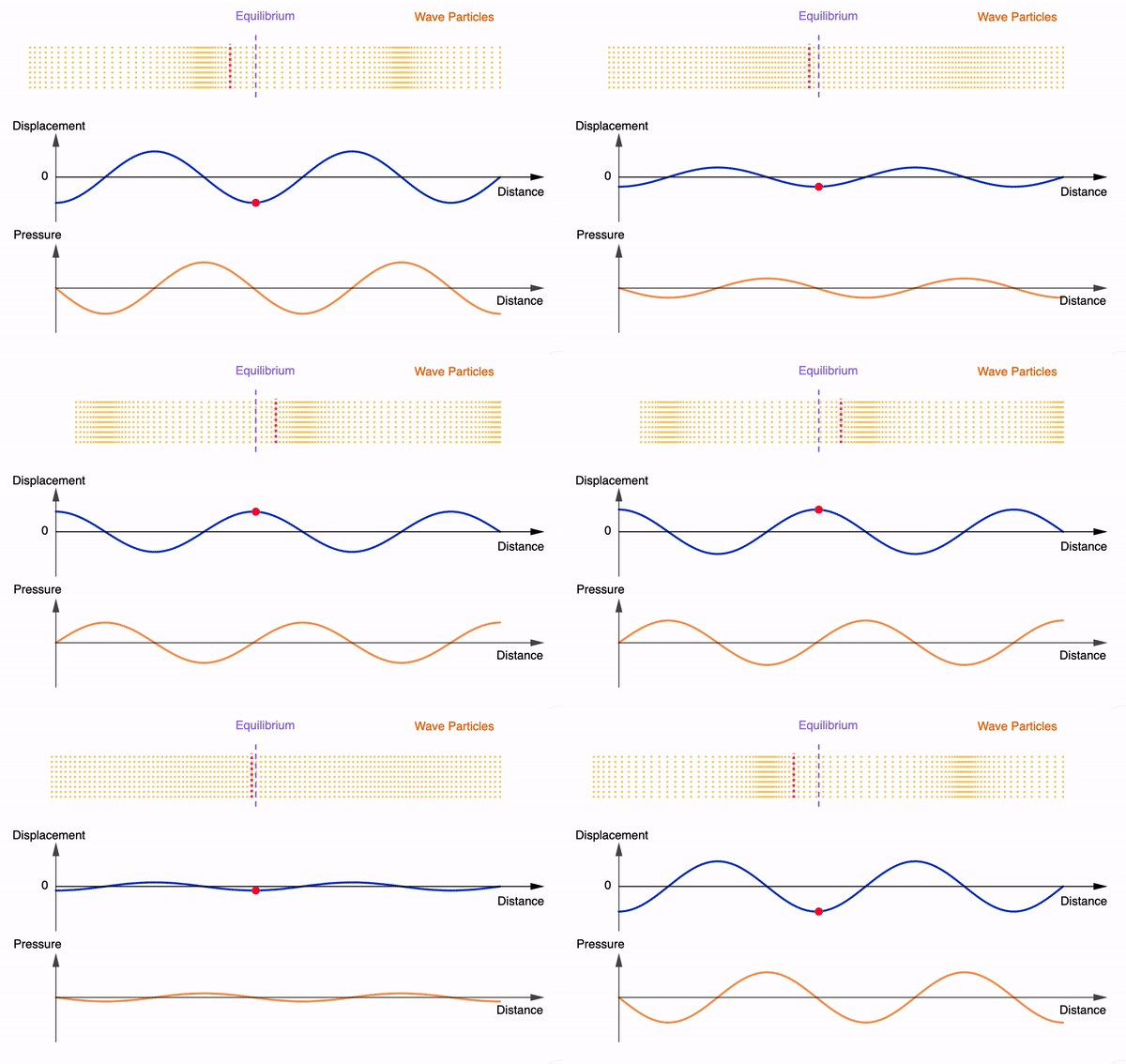
Pressure Nodes and Antinodes

Access in full screen here: https://www.geogebra.org/m/xbknrstt

I modified the progressive sound wave interactive into a stationary wave version.

This allows students to visualise the movement of particles about a displacement node to understand why pressure antinodes are found there.

Usually I will pose this question to students: where would a microphone pick up the loudest sound in a stationary sound wave? Invariantly, students will say it is at the antinode. When asked to clarify if it is the displacement antinode or pressure antinode, students then become uncertain.

According to Young & Geller (2007), College Physics 8th Edition, Pearson Education Inc. (pg 385), microphones and similar devices usually sense pressure variations and not displacements. In other words, the position within a stationary sound wave at which the loudest sound is picked up is at the displacement nodes which are the pressure antinodes.

For an alternative animation, check out Daniel Russell’s.

For embedding into SLS, please use the following code:

<iframe scrolling="no" title="Stationary Sound Wave (Displacement and Pressure)" src="https://www.geogebra.org/material/iframe/id/xbknrstt/width/640/height/480/border/888888/sfsb/true/smb/false/stb/false/stbh/false/ai/false/asb/false/sri/false/rc/false/ld/false/sdz/true/ctl/false" width="640px" height="480px" style="border:0px;"> </iframe>
This animation gif file demonstrates the movement of particles in a stationary sound wave, displaying the changing displacement-distance and pressure-distance graphs simultaneously. It can be inserted into slides and websites. Free to use!