Seng Kwang Tan

Hydraulic Elevator

This is a hydraulic lift kit for kids that was purchased online for only S$2.10 from Shopee, with free shipping! I am not, in anyway, affiliated to this, but simply sharing about one of several fun and cheap educational sets that I bought to occupy my kids during this mid-term break.

Other than the syringe, joints and tube, the parts are mainly laser-cut from a piece of wood with a thickness of two millimetres. The instructions come with pictures for each step so even though the words are in Chinese, there is no need to read them.

This kit demonstrates Pascal’s principle which states that a pressure change in one part of a closed container is transmitted without loss to every part. Hence, the pressure change is transmitted from one syringe to another, allowing work to be done. Do not expect it to lift up very heavy weights, though as the syringes are not perfectly sealed.

I shall share about other kits that I bought for this break soon, including a $6.62 Tesla coil that I am looking forward to testing.
Braking of a Magnetic Pendulum with Copper Plate

In this video, we will observe how induced eddy currents in a copper plate slow down a magnetic pendulum. 

When the pendulum is set in motion, it usually oscillates for quite a while. This pendulum consists of a strong magnet.

If we slide a copper plate underneath the magnet while it is in motion, the magnet comes to a stop quickly. Note that copper is not a ferromagnetic material, which means it does not get attracted to a stationary magnet.

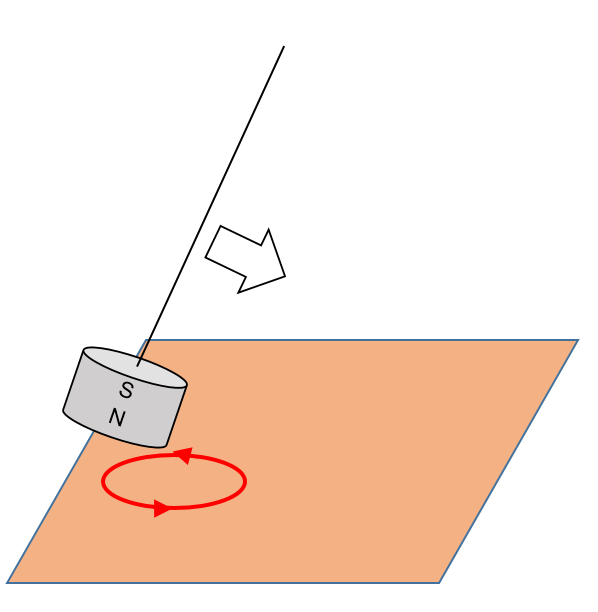
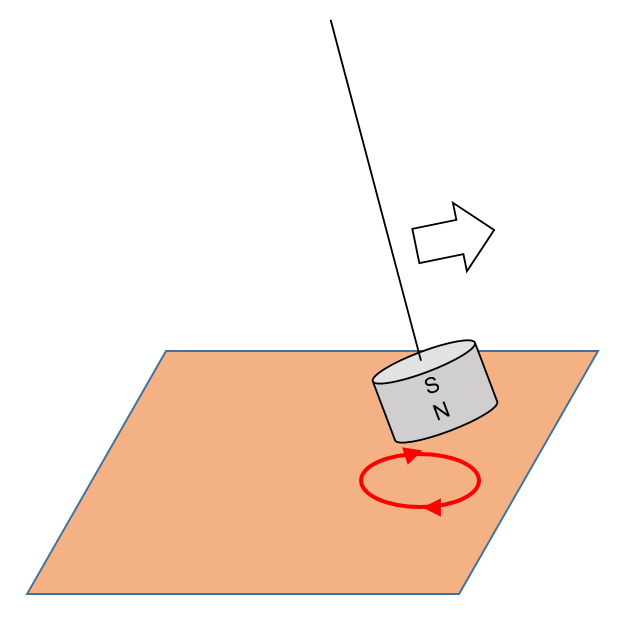
As the magnet moves across an area on the copper plate, the change in magnetic flux induces eddy currents on the plate. These eddy currents flow in such a way as to repel the magnet as it approaches the plate and attracts the magnet as it leaves the plate, therefore slowing the magnetic pendulum.

Eddy currents repels the magnet as it approaches
Eddy currents attracts the magnet as it leaves

When we pull the copper sheet out from under a stationary magnetic pendulum, the eddy currents will flow in such a way that it becomes attracted to the copper sheet.

Moving the copper sheet to and fro at a certain frequency (the pendulum’s natural frequency), the magnetic pendulum can be made to oscillate again.