This is a problem posed by a student today:
A boy of mass 40 kg is standing on a weighing machine inside a lift which is moving upwards. At a certain moment, the speed of the lift is $3.0 \text{ m s}^{-1}$ and it is decelerating at $2.0 \text{ m s}^{-2}$. What is the reading (in kg) shown on the weighing scale?
My advice for any dynamics problem is to take the direction of acceleration as positive. This way, you can apply Newton’s second law directly without worrying about inserting extra negative signs for deceleration. After all, a negative value of acceleration simply comes from the chosen sign convention—it reflects direction. For simplicity, putting the direction of acceleration as positive (in this case, downward is positive), we have
$$F_{net} = ma$$
The net force should therefore, be $W – N$, where $N$ is smaller than $W$.
$$W – N = ma$$
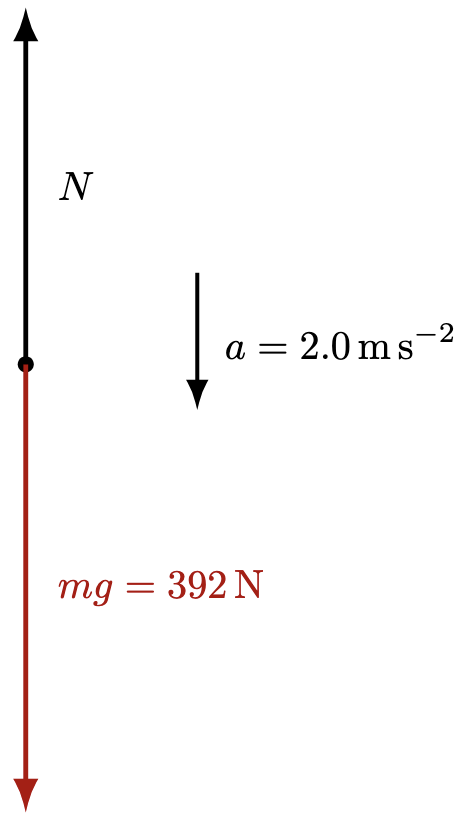
Substituting, we have
$$mg – N = ma$$
$$(40 \text{ kg} \times 9.81 \text{ N kg}^{-1}) – N = 40 \text{ kg} \times 2.0 \text{ m s}^{-2}$$
$$N = 312 \text{ N}$$
Note that $N$ is also known as apparent weight.
The mass reading due to this normal force = $\dfrac{312\text{ N}}{9.81 \text{ N kg}^{-1}} = 32 \text{ kg}$
(Notice here that the speed of the lift is irrelevant.)
The GeoGebra simulation allows you to modify the acceleration and observe the change in the vector representing the normal contact force, which is force acting on the weighing scale.
Open in new tab 🔗For a real-life experiment along with a visualisation of the changes in the vectors based on this scenario, check out my video and simulation.