15 Aug 2013 - Seng Kwang Tan 16 Circuits
Download Now Delight by Tan Seng Kwang is licensed under a Creative Commons Attribution-NonCommercial-ShareAlike 3.0 Unported License . An educational board game for 2 or any even...
 Download Now

Delight by
Tan Seng Kwang is licensed under a
Creative Commons Attribution-NonCommercial-ShareAlike 3.0 Unported License.
An educational board game for 2 or any even number of players (in 2 teams) based on the concepts of current electricity. Targeted at high school / junior college physics students, Delight is a fun way of practising the use of physics concepts such as
- electrical power $$P=\frac{V^2}{R}$$
- the potential divider rule.
- wires bypassing a device short-circuits it.
This game can be easily printed on A4 paper and the game pieces can be cut up for use.
Game Play
- This game is meant for 2 players or 2 teams of players. Each player/team has the following tiles:
- 2 x light bulbs
- 3 x T-shaped wires
- 2 x crossed wires
- The players will take turns to place the tiles on the board.
- Each new tile must have at least one wire connected to an existing wire on the board.
- The game will end when the last tile has been placed on the board.
- The person with the brightest bulb will win.In the event that there is an equal number of opposing bulbs of the same brightness, it will be considered a tie. If there are three bulbs of the same brightness, the one with two of these bulbs wins.
Test Yourself: Who is the winner for the games below?
GAME 1
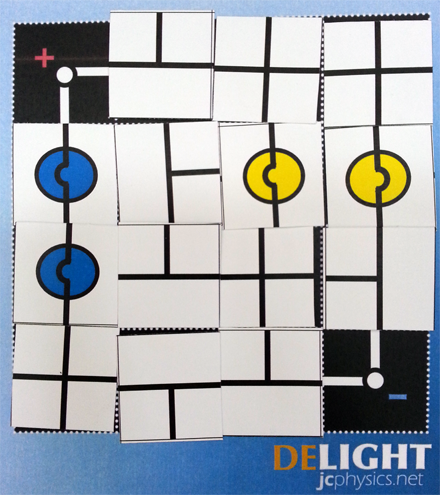 GAME 2
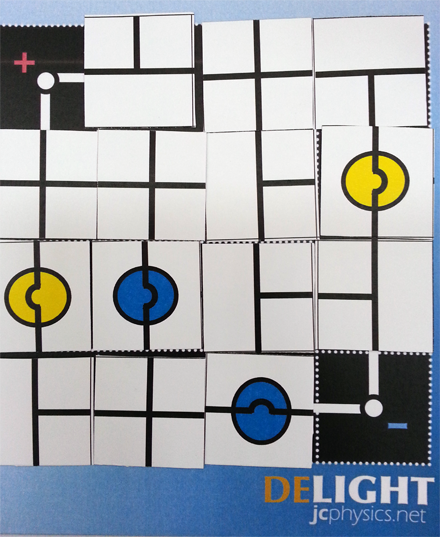 Conditions for Using this Game
- Anyone can print and use this game for free as long as it is for educational or personal use. Any other reproduction or republishing of this material, in hard copy or electronic form, without written permission, is prohibited.
- If you would like to make a suggestion or an enquiry, please leave a comment below.
08 Aug 2013 - Seng Kwang Tan 15 Currents
31 Jul 2013 - Seng Kwang Tan Subject Content
The Potential Divider Rule Determining the relative brightness of light bulbs using the potential divider rule How Internal Resistance affects brightness of light bulbs
The Potential Divider Rule
Determining the relative brightness of light bulbs using the potential divider rule
How Internal Resistance affects brightness of light bulbs
30 Jul 2013 - Seng Kwang Tan Subject Content
How emf is induced Electromagnetic Induction and its Effects To explain a phenomenon that happens due to Electromagnetic Induction, we can use an acronym CFILE to structure our...
How emf is induced
Electromagnetic Induction and its Effects
To explain a phenomenon that happens due to Electromagnetic Induction, we can use an acronym CFILE to structure our answer.
C stands for cutting of flux or changing of flux linkage. This is necessary for electromagnetic induction to happen. When a wire is pulled through a magnetic field perpendicular to it, it is said to be cutting the field lines. When a magnet enters a coil of wires, we can say that the magnetic flux linkage is increasing.
F stands for Faraday's law, which states that the induced e.m.f. in a circuit is directly proportional to the rate of change of flux-linkage or to the rate of cutting of magnetic flux.
I stands for an induced current. However, do note that this is only possible if there is a closed circuit or a path for the current to flow.
L stands for Lenz's law, which states that the direction of the induced e.m.f. is such that it tends to oppose the flux change causing it, and does oppose it if induced current flows.
E stands for effect. This is really just stating how an induced current or Lenz's law causes the phenomenon in question.
28 Jul 2013 - Seng Kwang Tan 03 Motion and Forces
A video tutorial on the use of the Addestation datalogger with its motion sensor to measure the displacement of a bouncing ball and to observe the velocity and acceleration using...
A video tutorial on the use of the
Addestation datalogger with its motion sensor to measure the displacement of a bouncing ball and to observe the velocity and acceleration using its differentiation function.