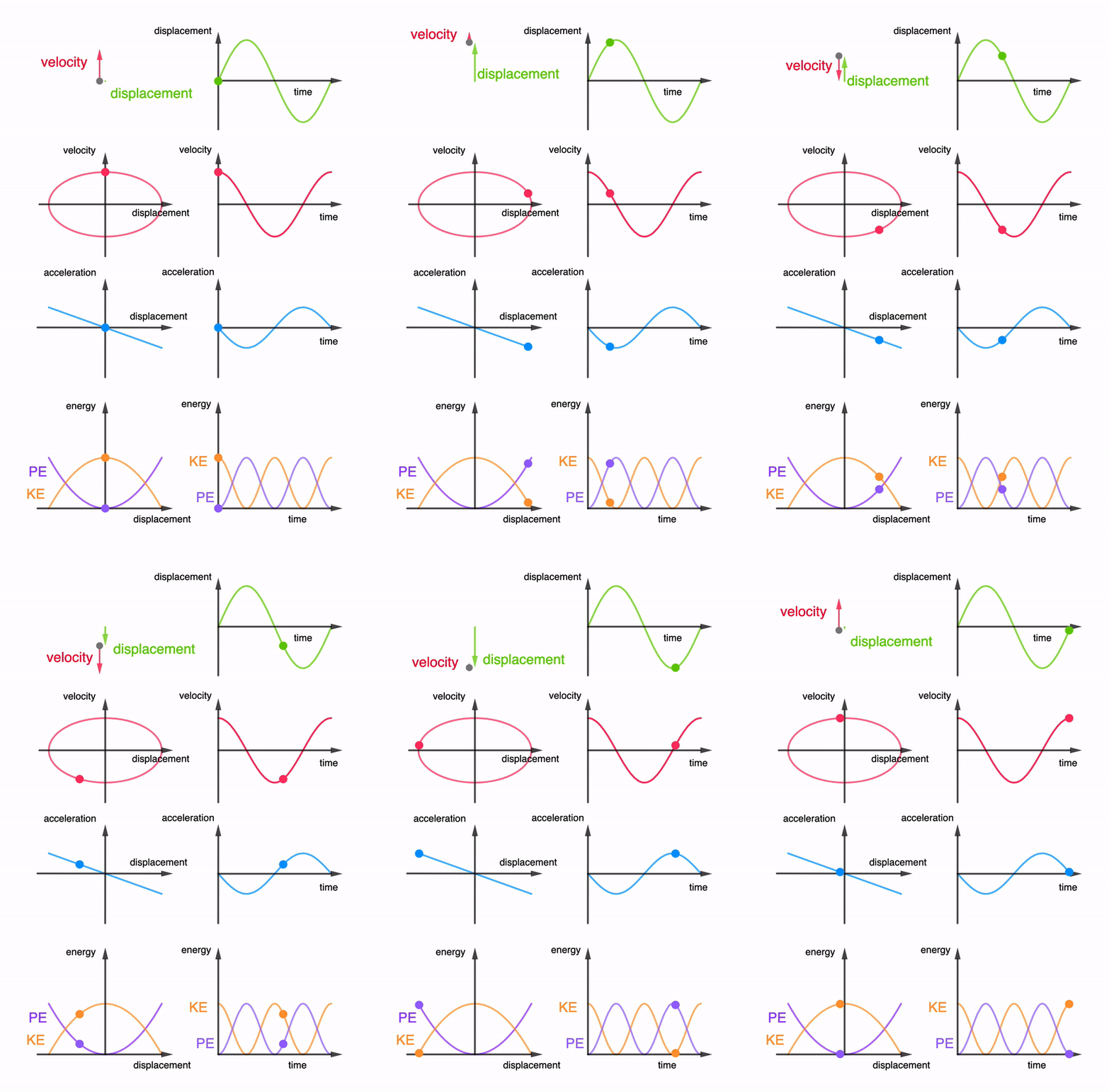
I have added two more graphs into the interactive animation. However, the app has become a bit sluggish when changing the period or amplitude. It still works smoothly when viewing...
I have added two more graphs into the interactive animation. However, the app has become a bit sluggish when changing the period or amplitude. It still works smoothly when viewing the animation.
Students ought to find it useful to look at all the graphs together instead of in silo. This way, they can better understand the relationships between the graphs.
Here is an animated gif for use on powerpoint slides etc.
Here's my attempt at animating 5 graphs for simple harmonic motion together in one page. From left column: $$v = \pm\omega\sqrt{x_o^2-x^2}$$ $$a = -\omega^2x$$ From right column:...
Here's my attempt at animating 5 graphs for simple harmonic motion together in one page.
From left column:
$$v = \pm\omega\sqrt{x_o^2-x^2}$$
$$a = -\omega^2x$$
From right column:
$$s = x_o\sin(\omega t)$$
$$v = x_o\omega \cos(\omega t)$$
$$a = -x_o\omega^2 \sin(\omega t)$$
And here is the animated gif file for powerpoint users:
The first of two apps on Phase Difference allows for interaction to demonstrate the oscillation of two different particles along the same wave with a variable phase difference....
The first of two apps on Phase Difference allows for interaction to demonstrate the oscillation of two different particles along the same wave with a variable phase difference.
The second shows two waves also with a phase difference.
In both cases, the phase difference $\Delta\phi$ can be calculated with
where $\Delta x$ is the horizontal distance between the two particles or the horizontal distance between the two adjacent identical particles (one from each wave) and $\lambda$ is the wavelength of the waves.
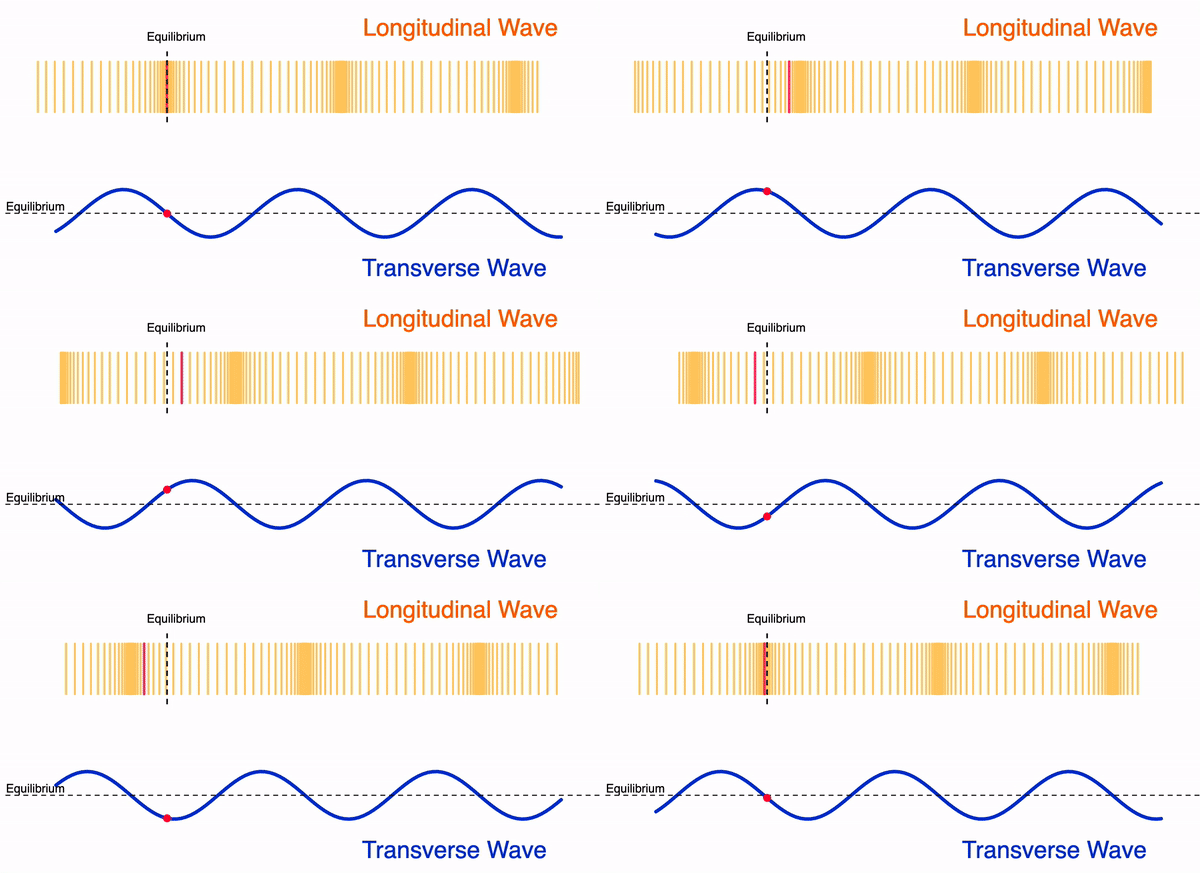
I modified Tom Walsh's original GeoGebra app to add a moveable single oscillating particle for students to observe its movement along a longitudinal wave and a transverse wave....
I modified Tom Walsh's original GeoGebra app to add a moveable single oscillating particle for students to observe its movement along a longitudinal wave and a transverse wave.
The app can also be used to show how the displacement of a particle in a longitudinal wave can be mapped onto a sinusoidal function, similar to the shape of a transverse wave. For example. a displacement of the particle to the right can be represented by a positive displacement value on the displacement-distance graph.
You can choose to select the particle that you want to focus on by using the slider.