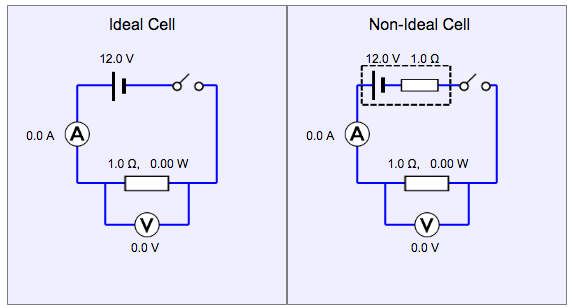
I've created this simulation to demonstrate the effect of an internal resistance due to a cell on the potential difference and current of an external load. One can also vary the...
I've created this simulation to demonstrate the effect of an internal resistance due to a cell on the potential difference and current of an external load.
One can also vary the internal resistance and external resistance to observe the maximum power theorem. The theorem states that for a given finite internal resistance, one can obtain the maximum external power only when the resistance of the load is equal to the internal resistance of the source.
My third simulation in as many days. This time round, I created some png files for electrical circuit components that can be used for future simulations. I also figured out how to...
My third simulation in as many days. This time round, I created some png files for electrical circuit components that can be used for future simulations. I also figured out how to add text in line with a variable in the drawing panel for the simulation, hence the units can now follow the values of the meter readings.
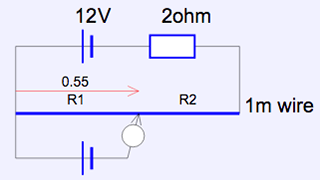
Continuing the course on Easy Java Simulation, I did this simple simulation on the Potentiometer, which allows students to first predict, and then verify the position of a jockey...
Continuing the course on Easy Java Simulation, I did this simple simulation on the Potentiometer, which allows students to first predict, and then verify the position of a jockey to achieve null deflection of a galvanometer.
Click on the image below to try it out and do give me your feedback. I'll try to improve it with whatever little skill I have.
I decided on a DC circuit simulation as I could not find many on Open Source Physics EJSS platform. With this as a template, I guess I can develop more simulations on the same topic when I have time.
This is a simulation done from scratch after attending a crash course on EJSS . It displays the velocity and acceleration vectors as an object is projected vertically upward with...
This is a simulation done from scratch after attending a crash course on EJSS. It displays the velocity and acceleration vectors as an object is projected vertically upward with a uniform downward acceleration. The initial upward velocity can be altered using a slider. The graph of velocity is traced as the ball moves.
02 Aug 2016 - Seng Kwang Tan 08 Gravitational Fields
I was reading up on tides this morning as I have to relieve a colleague's IP2 class on forces, when I stumbled upon this video. It explains tides in a way that differs from most...
I was reading up on tides this morning as I have to relieve a colleague's IP2 class on forces, when I stumbled upon this video. It explains tides in a way that differs from most textbooks that clarified for me why the oceans bulge at both ends along the Moon-Earth line at the 2'30" mark onwards.