Newton's Nightmare Simulation
This is an interactive simulation of Newton's Nightmare: a magnet moving through a conducting tube. It demonstrates Faraday's law, Lenz's law and eddy currents.
Physics Summary
When a magnet moves through a conducting tube, the magnetic flux through the tube changes. By Faraday's law, this changing flux induces circulating currents in the tube wall. These are called eddy currents.
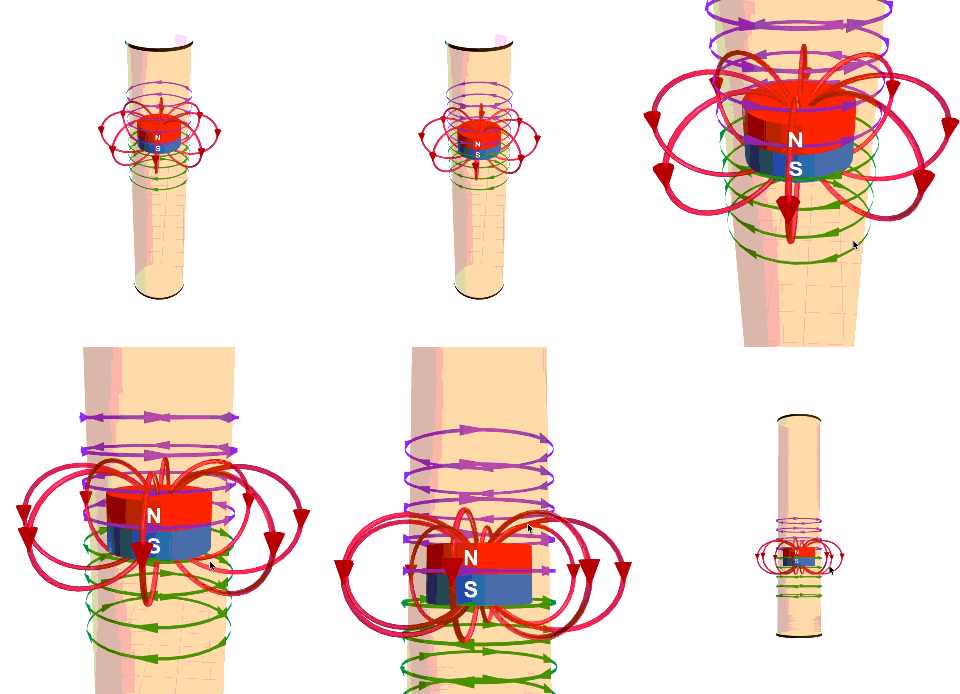
By Lenz's law, the induced current produces a magnetic field that opposes the change that caused it. For copper, aluminum, and brass, this creates magnetic braking. The magnet still falls, but more slowly than it would through a non-conducting tube.
Materials with lower resistivity allow stronger eddy currents. Stronger eddy currents create stronger magnetic braking.
The eddy currents flow in opposite directions above and below the falling magnet because the magnetic flux is changing in opposite ways in those two regions. Below the magnet, the magnet is approaching, so the magnetic flux through the tube is increasing. The induced current flows in the direction that creates a magnetic field opposing that increase. Above the magnet, the magnet is moving away, so the magnetic flux through the tube is decreasing. The induced current reverses direction to create a magnetic field that opposes that decrease.
In both cases, the current direction follows Lenz's law: the tube always responds by opposing the change in magnetic flux. That is why the app shows different current colors and opposite arrow directions on the rings above and below the magnet.
Steel behaves differently because it is ferromagnetic. Instead of smoothly falling through the tube, the magnet is attracted to the steel and sticks to the wall.
How To Use The App
- Choose a tube material from the material menu.
- Press Drop to release the magnet.
- Use Pause to freeze the simulation.
- Use Reset to return the magnet to the starting position.
- Adjust Animation Rate to slow down or speed up the simulation.
- Toggle magnetic field lines or eddy currents with the visualizer checkboxes.
- Read the velocity-time graph to compare how quickly the magnet falls in each material.